Confucius Famous Quotes 30 Timeless Sayings With Meaning
Looking for the most powerful Confucius famous quotes—without wading through endless, misattributed sayings?
You’re in the right place.
In this guide, you’ll get a curated list of Confucius quotes that are:
- Authentic (from the Analects and classical sources)
- Beautifully translated into clear modern English
- Paired with the original Chinese characters and pinyin
- Explained in simple language, with real-life examples you can actually use
You’ll also see how these ancient lines still shape life, education, family, and leadership across East Asia today—and why so many travelers end up tracing them back to Qufu, Confucius’ hometown in Shandong.
If you’ve ever wanted Confucius wisdom you can trust (for your own growth, a speech, social media, or even a tattoo), keep reading—this is your one-stop guide to his most timeless quotes.
How These Confucius Famous Quotes Were Selected
When I built this collection of Confucius famous quotes, I treated it like a careful restoration, not a quick copy‑paste from the internet. Every line had to be real, reliable, and genuinely helpful for modern life.
Rooted in the Analects of Confucius (Lunyu 論語)
I started with the primary classical sources, especially the Analects of Confucius (Lúnyǔ 論語), which is the most trusted record of Confucius’ conversations and teachings. From there, I cross-checked:
- Analects of Confucius (Lunyu 論語) – the main source for direct sayings
- Other early Confucian texts – like the Mencius and related classics
- Standard Chinese editions and reputable English translations – to keep both the Chinese and English accurate
If a quote doesn’t trace back to these sources or recognized commentaries, it didn’t make the cut.
Clear Criteria: Authenticity, History, Popularity
To keep this list clean and useful, I used three simple filters:
- Authenticity – The quote must be identifiable in the Analects of Confucius or core Confucian texts, not just “something from the internet.”
- Historical reliability – Wordings are checked against respected scholarly editions and mainstream Chinese references.
- Global popularity – I prioritized lines that people around the world already recognize, search for, and share as best Confucius sayings and Confucius quotes about life, education, and respect.
The result is a set of Chinese philosophy quotes that are both historically grounded and instantly recognizable.
Why These Confucius Famous Quotes Still Work Today
These Confucius wisdom quotes still resonate because they speak to problems we’re all facing:
- How to keep learning without burning out
- How to build character when no one is watching
- How to balance family, work, and personal values
- How to lead with integrity, not ego
Confucius talks about respect, effort, humility, and responsibility in a way that feels surprisingly modern—whether you’re a student, a parent, a manager, or just trying to live with a bit more clarity and peace.
How This List Helps You Grasp Confucius’ Core Teachings
I designed this collection as a practical doorway into Confucianism teachings, even if you’ve never read the classics:
- You see each quote in Chinese, pinyin, and modern English, so it’s easy to connect meaning with the original language.
- You meet the core Confucian ideas—humaneness (rén), ritual and respect (lǐ), righteousness (yì), wisdom (zhì), and trustworthiness (xìn)—through short, memorable lines.
- You get real-life angles you can apply right away: from family dynamics to leadership style, from daily discipline to inner balance.
Instead of wading through dense commentaries, you get a focused, high-quality set of Confucius famous quotes that lets you feel what Confucius was really trying to teach—and see how his voice still fits into your life today.
The 30 Most Famous Confucius Quotes (Grouped by Theme)
I’ve pulled together 30 of the most famous Confucius quotes and grouped them by theme, so you can quickly find what fits your life right now. Every quote is shown in Chinese, pinyin, and clear modern English, with a quick example of how it applies today.
Confucius Quotes About Learning and Personal Growth
- Chinese: 学而不厌,诲人不倦
Pinyin: Xué ér bù yàn, huì rén bù juàn
English: “Never tire of learning, and never get tired of teaching others.”
Real-life use: Perfect mindset if you’re always upskilling or mentoring at work. - Chinese: 学而时习之,不亦说乎
Pinyin: Xué ér shí xí zhī, bù yì yuè hū
English: “To learn and regularly review what you’ve learned—isn’t that a joy?”
Real-life use: Think of re-reading notes before a big exam or presentation. - Chinese: 知之为知之,不知为不知,是知也
Pinyin: Zhī zhī wéi zhī zhī, bù zhī wéi bù zhī, shì zhì yě
English: “To say you know when you know, and to say you don’t when you don’t—that is wisdom.”
Real-life use: Owning what you don’t know in a meeting instead of faking it. - Chinese: 敏而好学,不耻下问
Pinyin: Mǐn ér hào xué, bù chǐ xià wèn
English: “Be quick and eager to learn, and never be ashamed to ask those below you.”
Real-life use: Senior leaders asking junior staff for help on new tech tools. - Chinese: 三人行,必有我师焉
Pinyin: Sān rén xíng, bì yǒu wǒ shī yān
English: “When I walk with two others, each of them can be my teacher.”
Real-life use: Treat coworkers, friends, and even kids as people you can learn from.
Confucius Quotes on Character, Virtue, and Moral Integrity
- Chinese: 君子坦荡荡,小人长戚戚
Pinyin: Jūnzǐ tǎn dàng dàng, xiǎorén cháng qī qī
English: “The noble person is calm and at ease; the petty person is always anxious.”
Real-life use: Integrity lets you sleep at night; cutting corners doesn’t. - Chinese: 德不孤,必有邻
Pinyin: Dé bù gū, bì yǒu lín
English: “Virtue is never alone; it always has neighbors.”
Real-life use: Good character naturally attracts good people. - Chinese: 见贤思齐焉,见不贤而内自省也
Pinyin: Jiàn xián sī qí yān, jiàn bù xián ér nèi zì xǐng yě
English: “When you see the worthy, think of matching them; when you see the unworthy, examine yourself.”
Real-life use: Instead of judging others, use them as a mirror for your own behavior. - Chinese: 君子成人之美,不成人之恶
Pinyin: Jūnzǐ chéng rén zhī měi, bù chéng rén zhī è
English: “The noble person helps others do good, not do harm.”
Real-life use: Support coworkers’ wins; don’t fuel office drama. - Chinese: 忠恕而已矣
Pinyin: Zhōng shù ér yǐ yǐ
English: “Just be loyal and considerate—that’s all.”
Real-life use: Be true to your word and put yourself in other people’s shoes.
Confucius Quotes About Family, Relationships, and Society
- Chinese: 孝弟也者,其为仁之本与
Pinyin: Xiào dì yě zhě, qí wéi rén zhī běn yǔ
English: “Filial respect and brotherly harmony are the roots of human goodness.”
Real-life use: How you treat your parents and siblings shapes how you treat society. - Chinese: 己所不欲,勿施于人
Pinyin: Jǐ suǒ bù yù, wù shī yú rén
English: “What you do not want for yourself, do not do to others.”
Real-life use: The Confucian version of the Golden Rule—applies to everything from texting etiquette to business deals. - Chinese: 礼之用,和为贵
Pinyin: Lǐ zhī yòng, hé wéi guì
English: “In practicing ritual and manners, harmony is what matters most.”
Real-life use: Don’t obsess over perfect form—focus on keeping relationships smooth. - Chinese: 仁者爱人
Pinyin: Rén zhě ài rén
English: “The humane person loves others.”
Real-life use: Leadership, parenting, and friendship all start from genuine care. - Chinese: 与朋友交,言而有信
Pinyin: Yǔ péngyǒu jiāo, yán ér yǒu xìn
English: “In dealing with friends, let your word be trustworthy.”
Real-life use: If you say you’ll show up, show up.
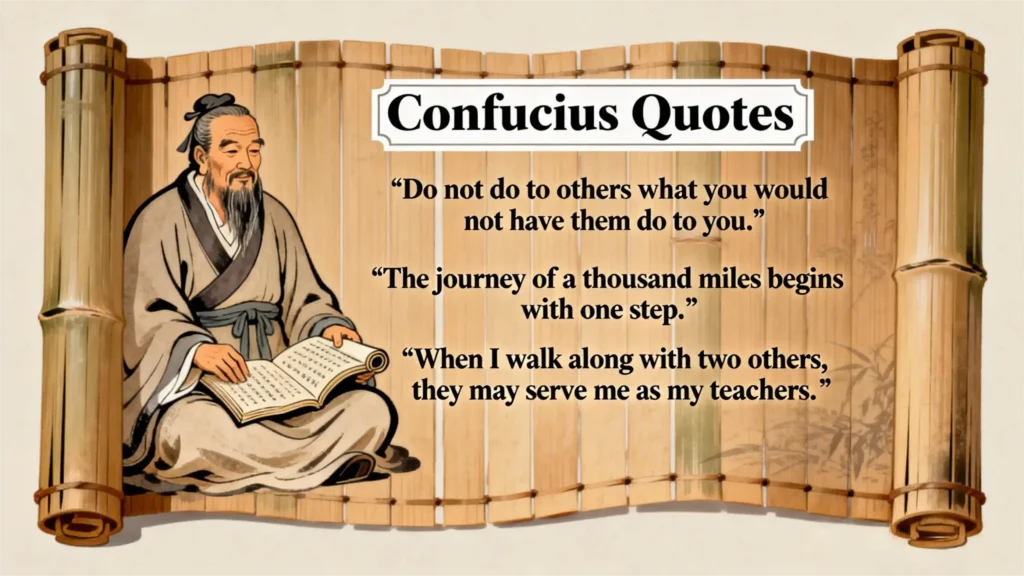
Confucius Famous Quotes on Leadership and Good Governance
- Chinese: 为政以德,譬如北辰,居其所而众星共之
Pinyin: Wéi zhèng yǐ dé, pìrú Běichén, jū qí suǒ ér zhòng xīng gòng zhī
English: “To govern by virtue is like being the North Star: it stays in place while all the stars revolve around it.”
Real-life use: Leaders lead best by example, not by fear. - Chinese: 道之以政,齐之以刑,民免而无耻;道之以德,齐之以礼,有耻且格
Pinyin: Dào zhī yǐ zhèng, qí zhī yǐ xíng, mín miǎn ér wú chǐ; dào zhī yǐ dé, qí zhī yǐ lǐ, yǒu chǐ qiě gé
English: “Rule by laws and punishments, and people will avoid trouble but feel no shame. Rule by virtue and rituals, and they’ll develop a conscience.”
Real-life use: Culture beats rules in any company or organization. - Chinese: 君子和而不同,小人同而不和
Pinyin: Jūnzǐ hé ér bù tóng, xiǎorén tóng ér bù hé
English: “The noble person seeks harmony, not uniformity; the petty person seeks uniformity, not harmony.”
Real-life use: Strong teams allow disagreement without destroying unity. - Chinese: 民无信不立
Pinyin: Mín wú xìn bù lì
English: “If the people have no trust, the state cannot stand.”
Real-life use: Trust is the real currency of government, brands, and leadership. - Chinese: 其身正,不令而行;其身不正,虽令不从
Pinyin: Qí shēn zhèng, bù lìng ér xíng; qí shēn bù zhèng, suī lìng bù cóng
English: “If a leader is upright, people will follow without orders; if not, they will disobey even when ordered.”
Real-life use: Your behavior as a boss or parent speaks louder than your rules.
Confucius Quotes About Life, Happiness, and Balance
- Chinese: 知者乐水,仁者乐山
Pinyin: Zhì zhě lè shuǐ, rén zhě lè shān
English: “The wise delight in water; the humane delight in mountains.”
Real-life use: Different personalities find peace in different kinds of environments. - Chinese: 不患无位,患所以立
Pinyin: Bù huàn wú wèi, huàn suǒ yǐ lì
English: “Don’t worry about having no position; worry about how to be worthy of one.”
Real-life use: Focus on skills and character before chasing titles. - Chinese: 知之者不如好之者,好之者不如乐之者
Pinyin: Zhī zhī zhě bùrú hào zhī zhě, hào zhī zhě bùrú lè zhī zhě
English: “Those who know it are not as good as those who love it; those who love it are not as good as those who find joy in it.”
Real-life use: The people who truly enjoy their work outperform those who just “get it.” - Chinese: 不在其位,不谋其政
Pinyin: Bù zài qí wèi, bù móu qí zhèng
English: “If you’re not in that position, don’t meddle in its responsibilities.”
Real-life use: Stay in your lane at work unless you’re asked to step in. - Chinese: 饱食终日,无所用心,难矣哉
Pinyin: Bǎo shí zhōng rì, wú suǒ yòng xīn, nán yǐ zāi
English: “To eat your fill all day without applying your mind—how difficult that is (to justify).”
Real-life use: A comfortable but aimless life doesn’t feel good for long.
Confucius Quotes on Self-Reflection, Wisdom, and Inner Peace
- Chinese: 吾日三省吾身
Pinyin: Wú rì sān xǐng wú shēn
English: “Each day I examine myself on three points.”
Real-life use: A daily check-in: Was I honest, reliable, and respectful today? - Chinese: 攻乎异端,斯害也已
Pinyin: Gōng hū yìduān, sī hài yě yǐ
English: “Obsessing over strange doctrines only brings harm.”
Real-life use: Don’t get lost in distractions and conspiracy theories; stay grounded. - Chinese: 知者不惑,仁者不忧,勇者不惧
Pinyin: Zhì zhě bù huò, rén zhě bù yōu, yǒng zhě bù jù
English: “The wise are not confused, the humane are not anxious, the brave are not afraid.”
Real-life use: Aim for clarity, kindness, and courage instead of chasing status. - Chinese: 不怨天,不尤人
Pinyin: Bù yuàn tiān, bù yóu rén
English: “Do not resent Heaven, do not blame others.”
Real-life use: Take responsibility instead of living in complaint mode. - Chinese: 内省不疚,夫何忧何惧
Pinyin: Nèi xǐng bù jiù, fú hé yōu hé jù
English: “If inwardly, on examining myself, I find no shame, why should I worry or fear?”
Real-life use: When your conscience is clear, anxiety drops way down.
Real-Life Ways to Use Confucius Wisdom Today
Here’s how these famous Confucius quotes actually show up in everyday American life:
- Career & education:
- Use “学而时习之” as a reminder to review notes weekly, not just before tests.
- Apply “不患无位,患所以立” when building your résumé—grow your value first.
- Family & relationships:
- Bring “己所不欲,勿施于人” into how you text, argue, and set boundaries.
- Use “与朋友交,言而有信” as your rule for keeping strong friendships.
- Leadership & business:
- Lead with “为政以德” as your model: your character is your management style.
- Build team culture around “君子和而不同” to allow healthy disagreement.
- Mental health & inner peace:
- Create a quick nightly “吾日三省吾身” reflection routine.
- Use “内省不疚,夫何忧何惧” as a filter: if you’d be ashamed later, don’t do it now.
If you want to go deeper into more quotes by Confucius in Chinese and English with travel-ready background stories, I’ve curated a broader collection on my Confucius quotes page at this dedicated Confucius wisdom and sayings guide.
Top 5 Confucius Famous Quotes the World Shares the Most
When people talk about Confucius famous quotes online, a small handful show up over and over. These are the lines you’ll see on Instagram posts, graduation speeches, classroom walls, and business presentations.
Here are 5 of the most shared Confucius quotes, in simple modern English, plus why they connect so strongly today.
- “Isn’t it a pleasure to study and practice what you have learned?”
- Used in: Education, study motivation, teacher appreciation
- Why it spreads: It nails the idea that learning isn’t just a duty, it’s a lifetime joy. Perfect for students, lifelong learners, and anyone building new skills.
- “To see what is right and not do it is a lack of courage.”
- Used in: Leadership talks, ethics training, social justice posts
- Why it spreads: It speaks directly to moral responsibility. Simple, direct, and powerful—great for speeches and posts about doing the right thing, even when it’s hard.
- “When you see a worthy person, think of becoming their equal. When you see an unworthy person, examine yourself.”
- Used in: Self-reflection, mentorship, character-building content
- Why it spreads: It flips judgment into self-improvement. Social media loves this because it ties humility, growth, and emotional intelligence into one short quote.
- “If you govern by virtue, it is like the North Star: it stays in place and all the other stars revolve around it.”
- Used in: Political speeches, leadership books, management trainings
- Why it spreads: It’s a clear image of values-based leadership. Easy to visualize, easy to quote, and perfect for anyone teaching that character matters more than control.
- “The noble person is calm and at peace; the small person is always anxious and full of worry.”
- Used in: Mental health discussions, mindset coaching, life advice content
- Why it spreads: It connects virtue with inner peace, something a lot of people in the U.S. are actively seeking. It plays well in wellness, coaching, and inspirational spaces.
Why These Confucius Famous Quotes Travel So Well Across Cultures
These lines are everywhere because:
- They’re short and visual. Easy to turn into graphics, slides, and captions.
- They hit universal themes: learning, courage, leadership, self-reflection, inner peace.
- They’re practical, not abstract. You can apply each quote directly to school, work, family, or leadership.
- They feel timeless. Even though they come from the Analects of Confucius, the problems—stress, ethics, ambition—are the same ones we deal with now.
If you ever visit Qufu, Confucius’ hometown in Shandong, you’ll see these same ideas woven into local culture, especially around the Confucius Temple and Mansion. I strongly recommend checking a focused resource like this Qufu culture and Confucius heritage guide if you want to connect the quotes you see online with the real places and traditions behind them.
Common Misattributed Confucius Famous Quotes
A lot of “Confucius famous quotes” that go viral online or show up on posters were never said by Confucius at all. If you care about real Confucius wisdom and the Analects of Confucius, it’s worth knowing which lines are fake and how to check them.
Popular Quotes People Think Confucius Said
Here are some of the most commonly misattributed Confucius quotes in English:
- “Choose a job you love, and you will never work a day in your life.”
- Not in the Analects of Confucius.
- Likely a modern motivational quote loosely inspired by Chinese philosophy quotes about joy in one’s work.
- “Our greatest glory is not in never falling, but in rising every time we fall.”
- No direct match in Confucius’ teachings.
- Much closer to ideas in Western writers like Oliver Goldsmith or later paraphrases.
- “Everything has beauty, but not everyone sees it.”
- Based on a real idea, but the wording is very modern. Confucius does talk about recognizing virtue and goodness, but not in this smooth Instagram style.
- “When you are angry, think of the consequences.”
- Sounds Confucian, but again, the exact line isn’t in the Analects. It’s a modern simplification of broader Confucianism teachings on self-control and ritual behavior.
- “Life is really simple, but we insist on making it complicated.”
- Popular online as a Confucius quote, but no such sentence appears in the classical text.
These feel “Confucian” because they touch themes Confucius did care about—virtue, balance, character—but the wording you see on social media isn’t what he actually said.
Where These Misquotes Usually Come From
Most fake or “too smooth” Confucius quotes come from:
- Modern self‑help and business books that want ancient authority behind their advice.
- Loose paraphrases of Confucian ideas by translators or writers, then repeated as if literal quotes.
- Generic “ancient Chinese proverbs” that people later slap Confucius’ name on.
- Mistranslations or over‑simplifications of dense classical Chinese phrases into short, catchy English lines.
Over time, repetition on the internet makes these lines sound just as real as the best Confucius sayings, even though they’re not.
How to Check if a Confucius Quote Is Authentic
If you want to know whether a Confucius quote is legit, here’s a simple process I use:
- Check if it appears in the Analects of Confucius (Lúnyǔ 論語).
- Confucius’ most trusted sayings are from the Analects.
- If the quote isn’t there, be cautious. The vast majority of real quotes by Confucius in Chinese and English can be traced to this book.
- Look at the language style.
Ask yourself:- Does this sound like modern motivational speech?
- Is it a smooth, symmetrical sentence in English, like a TED Talk line?
If yes, it’s probably not literal Confucius, even if the spirit is similar.
- Search for the original Chinese.
- Legit Confucius quotes will usually list:
- Chinese: characters (e.g., 子曰:學而不思則罔,思而不學則殆。)
- Pinyin: zǐ yuē: xué ér bù sī zé wǎng, sī ér bù xué zé dài.
- Source: Analects + chapter (e.g., Analects 2.15).
- If no one can show you the Chinese original or Analects reference, it’s probably made up or highly paraphrased.
- Legit Confucius quotes will usually list:
- Use reliable references.
- Look for serious translations and commentaries on Confucianism teachings, not quote-image sites.
- Biographical and historical pages, like travel and culture resources about who Confucius was, usually stick closer to authentic material.
- Be careful with “Chinese proverb” labels.
- “Chinese proverb” does NOT automatically mean Confucius. China has thousands of years of thinkers; most sayings are anonymous folk wisdom, not from Kong Qiu (Confucius) himself.
Why Authentic Confucius Wisdom Matters
For readers in the U.S. who value real sources, being able to separate authentic Confucius quotes about life, learning, and moral character from internet fluff actually helps:
- You get clear insight into his true voice, not a modern marketing rewrite.
- You can study the Analects directly and see how core ideas like respect, family, and self‑cultivation really work.
- You avoid building your understanding of Chinese philosophy quotes on lines he never said.
When in doubt, assume the slick, poster-ready one-liner probably isn’t from the Analects. Confucius’ real words are often shorter, sharper, and less “cute”—but much deeper when you sit with them.
How Confucianism Shapes Modern Life
Confucianism isn’t just “old Chinese wisdom.” It still quietly shapes how people study, work, lead, and relate to each other across East Asia today—and you feel it fast if you visit, do business, or send your kids to school there.
Confucius’ Influence on Education and Exams
Confucius saw learning as a lifelong duty, not a phase. That mindset still drives how seriously education is taken in places like China, Korea, Japan, and Singapore.
You see Confucius’ impact in:
- High‑stakes exams: From China’s gaokao to Korea’s CSAT, the idea that hard study and merit can lift you up comes straight from the old imperial exam system, which was built on Confucian classics.
- Respect for teachers: Teachers are treated almost like second parents. Teacher’s Day, bowing to teachers, and formal classroom manners all reflect Confucius’ view that teachers guide both knowledge and character.
- Character + grades together: Schools don’t just push test scores. They talk about virtue, discipline, respect, and service, which are core Confucian values.
If you’re a parent in the U.S. looking at East Asian education models, you’re basically looking at modern versions of a Confucian playbook: grind, respect, and responsibility.
Confucius, Family Values, and Social Harmony
Confucius put family at the center of everything. That’s still obvious across East Asia—and it explains a lot of behaviors that feel “different” to American visitors.
Key family values with Confucian roots:
- Filial piety (xiào, 孝): Deep duty to care for parents and elders. Adult kids living close to parents, sending money home, prioritizing mom and dad’s needs—this is all Confucian.
- Respect for age and hierarchy: You often:
- Let elders eat first
- Use polite titles instead of first names
- Defer to older family members in decisions
- Harmony over confrontation: Instead of arguing in public or “telling someone off,” people often keep the peace, avoid direct conflict, and protect relationships.
For U.S. travelers and businesspeople, understanding this helps you read between the lines: silence doesn’t always mean agreement; it can mean “let’s keep harmony.”
Confucian Ideas in Business, Leadership, and Government
Confucianism shapes how leaders are expected to behave—and how teams function day to day.
In business culture, you’ll see:
- Relationship-first networking: Long dinners, formal meetings, and patient trust-building reflect Confucius’ focus on loyalty and long-term ties.
- Respectful hierarchy: People often wait for the boss to speak, avoid openly contradicting leaders, and use formal titles—this flows from Confucian respect for order.
- Leaders as moral role models: The ideal boss is not just “the smartest” but the most upright—fair, self-controlled, responsible for the group’s well-being.
In government and public life:
- Emphasis on social stability, order, and duty
- Strong focus on education, exams, and civil service quality
- Expectation that officials should be ethical and benevolent, at least in principle
If you’re managing teams or negotiating deals in East Asia, leaning into respect, patience, and consistency lines up closely with Confucian expectations.
What Still Feels Confucian When You Travel in China and East Asia
On the ground, Confucianism doesn’t show up as a “religion” most of the time—it shows up as habits, etiquette, and atmosphere.
Things that feel very Confucian when you visit:
- Bowing or formal greetings to elders, teachers, and leaders
- Orderly public behavior: low tolerance for chaos, loud arguments, or open disrespect
- Attention to titles: “Teacher Li,” “Manager Wang,” “Director Kim” instead of first names
- Rituals of respect: ancestor tablets, incense, memorial halls, and family altars
- Quiet discipline in schools and tourist sites—students moving in groups, lined up, listening to guides
In cities like Qufu, the hometown of Confucius, you feel this even more strongly. The Confucius Temple in Qufu and its ritual spaces show how the teachings turned into lived tradition, ceremony, and architecture. If you want to see how Confucianism in Qufu compares with other parts of China, it’s worth checking a more detailed breakdown of Confucianism in Qufu vs. other regions so you know what’s cultural, what’s local, and what’s truly Confucian at the core.
Experience Confucius’ Wisdom in Qufu
If you really want Confucius’ famous quotes to hit home, go where they were lived, not just written—Qufu, his hometown in Shandong. I treat Qufu as a full “Confucius experience,” not just another sightseeing stop.
Why Qufu Is the Spiritual Home of Confucius
Qufu is where Confucius (Kǒng Qiū, 孔丘) was born, taught, and where his descendants lived for generations. It’s the physical backdrop behind many of the Analects scenes you read about in books.
What stands out when you’re in Qufu:
- Daily life still reflects Confucian values—respect for elders, rituals, education, and family.
- The whole old town feels like a living classroom for Confucius wisdom and Chinese philosophy.
- Confucius isn’t treated like a “celebrity”; he’s treated like an ancestor and teacher.
If you want a quick feel for the city’s history and culture, I’d start with this overview of Qufu’s history and Confucian culture.
Visiting the Temple and Mansion of Confucius
These two sites sit right in the center of Qufu and are must-visits if you care about authentic Confucius quotes and Confucianism teachings.
Confucius Temple (Kǒng Miào, 孔庙)
- One of China’s most important Confucius temples.
- Stone steles, halls, and ancient trees form a powerful backdrop for Chinese philosophy quotes.
- Great spot to reflect on Confucius quotes about life, education, and respect.
Kong Family Mansion (Kǒng Fǔ, 孔府)
- Former residence of Confucius’ descendants, the Kong family.
- Helps you see how family, hierarchy, and ritual were applied in real life.
- Walk the courtyards and imagine lines like “Respect yourself and others will respect you” being passed down through generations.
Exploring the Cemetery of Confucius and Kong Family Rituals
The Confucius Cemetery (Kǒng Lín, 孔林) is where Confucius and thousands of his descendants are buried. It’s quiet, shaded, and surprisingly peaceful.
Here’s how I’d approach it:
- Start at Confucius’ tomb and read a short Confucius quote on respect and family to frame the visit.
- Notice how the layout reflects filial piety, lineage, and continuity—key Confucian values.
- If you time it right, you may see or hear about Kong family-style memorial rituals that keep these teachings alive.
For a deeper dive into the site and what to look for, I recommend checking a focused guide to the Confucius Cemetery and Kong family graves.
Best Photo Spots in Qufu to Pair with Confucius Famous Quotes
If you like combining travel and meaningful captions, Qufu is perfect for pairing Confucius quotes about life with strong visuals:
- Under the ancient cypress trees in Confucius Temple
- Great for quotes on time, learning, and patience.
- Temple gates and stone archways
- Use for Confucius quotes on education and “journey to the East” style wisdom.
- Quiet courtyards in the Kong Mansion
- Perfect for lines on family, discipline, and daily ritual.
- Pathways inside the Confucius Cemetery
- Ideal for reflections on life, death, and legacy.
- City walls and old streets of Qufu
- Good for broader Confucius quotes about life and balance.
Tip: Keep your quote short, clean, and authentic. Simple English translations of Analects lines work best in captions.
Planning Your Qufu Trip Around the Confucius Cultural Festival
If your schedule allows, plan your visit around the Confucius Cultural Festival, usually held around Confucius’ birthday (September 28).
What you can expect:
- Traditional ritual ceremonies honoring Confucius.
- Performances in ancient clothing, music, and dance.
- Activities centered on Chinese philosophy, education, and Confucianism teachings.
- A stronger “living culture” feel than a normal tourist day.
For travelers from the United States, here’s how I’d plan it:
- Aim for 3 days in Qufu: Temple + Mansion on day one, Cemetery and old town on day two, flexible wrap-up on day three.
- Build in time just to sit, read a few of the best Confucius sayings, and let the place sink in.
- Use Qufu as your base if you’re doing a broader Shandong and East China “wisdom journey” that includes other historic sites.
Qufu isn’t just where Confucius came from—it’s where his words still feel lived-in, not just quoted.
Confucius Famous Quotes FAQ
What is Confucius’ most famous quote?
Different cultures highlight different lines, but one of the most widely shared Confucius famous quotes is the “Golden Rule” style teaching:
“What you do not wish for yourself, do not do to others.”
Here’s a quick breakdown:
| Item | Text |
|---|---|
| Chinese | 己所不欲,勿施于人。 |
| Pinyin | jǐ suǒ bù yù, wù shī yú rén |
| Simple English | Don’t treat others in ways you wouldn’t want for yourself. |
You’ll also see these core Confucius quotes repeated a lot:
- Learning & growth: “Is it not a joy to learn and practice what you have learned?” (學而時習之,不亦說乎)
- Character: “The superior person is modest in speech, but exceeds in actions.” (君子欲訥於言,而敏於行)
When you see “best Confucius sayings” or “Confucius quotes about life,” most authentic ones trace back to the Analects of Confucius (Lúnyǔ).
Did Confucius really say “Choose a job you love, and you will never work a day in your life”?
No. Confucius did not say that line.
- The quote does not appear in the Analects of Confucius or other early Confucian texts.
- It first shows up in English sources many centuries later.
- It sounds “Confucian,” but it’s a modern inspirational saying, not an ancient Chinese proverb.
If you want authentic Confucius wisdom on work and learning, look for quotes that:
- Cite a chapter/section from the Analects (for example, Analects 2.4).
- Include the original Chinese and pinyin.
- Are referenced by reputable scholars or classical Chinese philosophy books.
Where is the best place to experience Confucianism and Confucius quotes today?
If you want to feel these Confucius quotes come to life, the best place is Qufu, Shandong, Confucius’ hometown.
In one compact city, you can:
- Walk through the Confucius Temple, where emperors once offered rituals.
- Explore the Kong Family Mansion, which carried on Confucian traditions for centuries.
- Visit the Cemetery of Confucius (Kong Lin), where generations of the Kong clan are buried.
For a practical overview of the city layout, must-see Confucius sites, and how to plan your time, I recommend starting with this detailed Qufu tourism guide for first-time visitors.
Are there English-friendly Confucius tours and guides in Qufu?
Yes. You can absolutely experience Confucianism in Qufu with English support.
Typical options:
- Private English-speaking guides who walk you through the Confucius Temple, Mansion, and Cemetery.
- Small-group tours that focus on Confucianism teachings, ritual spaces, and local culture.
- Custom day trips from nearby cities like Jinan or Tai’an (Mount Tai), with hotel pickup.
When I build trips for U.S. travelers, I focus on:
- Clear, simple explanations of key Confucius quotes and stories.
- Enough free time for photos and quiet reflection.
- Easy logistics (train tickets, local transfers, ticket timing).
You can use our city overview and practical tips in this Qufu guide for independent travelers to choose the style of tour that fits you best.
How do you pronounce Confucius’ name in Chinese (Kǒng Fūzǐ)?
The name “Confucius” is the Latinized version of his Chinese honorific Kǒng Fūzǐ (孔夫子), which literally means “Master Kong.”
Quick guide:
| Item | Details |
|---|---|
| Chinese characters | 孔夫子 |
| Standard pinyin | Kǒng Fūzǐ |
| Rough sound | “kong foo-dzuh” |
| Meaning | “Master Kong” |
You may also see:
- Kong Qiu (孔丘) – his personal name.
- Kongzi (孔子) – “Master Kong,” a very common form in Chinese.
Knowing these versions helps when you search for authentic Chinese philosophy quotes, Confucianism teachings, and local signs around the Confucius Temple in Qufu.


You May Also Like
Who Was Confucius Exploring His Life Teachings and Legacy

Confucius Symbol Meaning and Iconic Representations in Qufu