Best Confucius Book Guide for Travelers to Qufu
Planning a trip to Qufu and wondering which Confucius book you should read first?
You’re not alone.
With the Analects of Confucius, the Four Books, and the Five Classics all competing for attention, it’s easy to feel overwhelmed before you even step through the gates of the Qufu Confucius Temple.
In this guide, you’ll cut straight to the essentials:
- Which Confucius books are best for beginners
- How the Analects, Great Learning, and Doctrine of the Mean actually connect to the streets, courtyards, and cypress groves of Qufu
- Simple ways to weave Confucian philosophy basics into your itinerary so every temple, stone stele, and incense offering suddenly makes sense
If you want more than just photos—and prefer a journey where each site echoes a line from the Analects of Confucius—you’re in the right place.
Who Was Confucius?
If you’ve ever seen a “Confucius says…” quote and wondered who this person actually was, you’re not alone. Before we dive into any Confucius book, it helps to know the man behind the ideas.
Confucius: A Quick Biography Overview
Confucius (Kongzi in Chinese) lived around 551–479 BCE in what is now eastern China. He was born in the small state of Lu, not into royalty, but into a family with modest status and limited wealth.
A few key points about his life:
- He lost his father at a young age and grew up with hardship.
- He worked various jobs (including minor government roles) before becoming a full-time teacher.
- He never became a powerful ruler or general. Instead, he became known as a moral teacher, a scholar, and a practical philosopher.
What’s striking is that Confucius didn’t build an empire, write dramatic speeches, or lead armies. He taught small groups of students, walked from state to state looking for a ruler who would listen, and spent his life trying to improve society through education and ethics.
Confucius as Teacher and Thinker, Not a Ruler
In a world full of kings and warlords, Confucius was different. He believed that:
- Real power comes from character, not weapons.
- The best way to change a country is to educate its people and improve its leaders’ morals.
- A ruler should lead by example, like a good parent or a respected teacher.
Think of him less like a politician and more like:
- A tough but caring mentor
- A coach who insists on discipline and effort
- A wise elder who believes you can be better and expects you to try
He taught through conversations, short sayings, and stories. His students remembered his words, lived by them, and passed them on.
Core Ideas: Virtue, Education, and Social Harmony
Confucius’s philosophy is built around a few simple but powerful ideas you’ll see repeated in every Confucius book:
-
Virtue (moral character)
- The Chinese word often used is “de” (moral virtue).
- Confucius believed that who you are on the inside matters more than what you own or what title you have.
- A good person shows honesty, kindness, courage, and integrity in daily actions.
-
Education and self-improvement
- Confucius is famous for Confucius quotes about learning, like:
“Is it not a pleasure to study and practice what you have learned?” - He believed anyone, not just nobles, could grow through learning.
- For him, learning wasn’t just books—it was reflecting on your behavior, correcting mistakes, and improving a little every day.
- Confucius is famous for Confucius quotes about learning, like:
-
Social harmony
- Confucius wanted a world where people respect each other’s roles and cooperate.
- Harmony starts with the individual, then family, then community, then the whole country.
- He taught that if people are virtuous and respectful, laws and punishments become less necessary.
At the heart of Confucian philosophy are two famous concepts:
- Ren (benevolence, human-heartedness):
Being genuinely kind, empathetic, and humane in how you treat others. - Li (ritual, respect, proper behavior):
Knowing how to act appropriately—in family, at work, in public—so everyone feels respected and secure.
Together, ren and li shape the Confucius teachings on virtue, family, and leadership that show up in almost every classic Confucius book.
Why Confucius Still Matters Today
So why do people in the United States—and around the world—still read Confucius today?
Because his questions are still our questions:
- How do I become a better person?
- How do I raise respectful, kind children?
- How do we build workplaces that are fair and humane, not just profitable?
- What makes a leader truly worthy of respect?
Confucian philosophy offers:
- Confucius wisdom for daily life: simple, direct advice for how to act with integrity.
- Confucius teachings on virtue: how to build character through small, consistent actions.
- Confucius for personal growth: a roadmap for improving yourself without needing special talent or money.
- Confucius quotes about leadership: insights on leading by example, not fear.
Even in modern leadership training and business ethics, you’ll find Confucian ideas:
- Lead with character, not ego.
- Respect others’ dignity.
- Think long term, not just about quick wins.
These values resonate strongly today, especially in a world where people are tired of empty slogans and are looking for authentic, grounded wisdom.
Confucius and Chinese Culture and History
Confucius’s impact on Chinese culture is huge. For more than 2,000 years, his teachings shaped:
- How children were taught in school
- How government officials were selected and trained
- How families organized their roles and responsibilities
- How people understood respect, loyalty, and duty
Some ways Confucius connects to Chinese and East Asian culture:
- Education and exams: For centuries, government jobs in China depended on exams based on Confucian classics.
- Family and filial piety: Confucius emphasized filial piety—respecting and caring for parents and elders. This idea still influences family life in China, Korea, Japan, and other East Asian societies.
- Respect and ritual: Everyday manners, from how you greet elders to how you act at important events, carry Confucian roots emphasizing dignity and order.
- Moral language: Many common sayings in Chinese come straight from Confucius sayings and aphorisms.
If you want to understand East Asian culture, history, and values—even modern business culture—reading a Confucius book is one of the most direct ways to start. His ideas are woven into everything from school systems to corporate etiquette, often in ways people don’t even realize.
In short: Confucius was not a king, not a conqueror, and not a religious prophet. He was a brilliant teacher and practical thinker who believed that better people create a better world. His focus on virtue, education, and social harmony has made his books and quotes timeless guides, whether you’re a student, a parent, a manager, or simply someone trying to live with a little more wisdom and integrity.
What Is the Main Confucius Book?

When people in the U.S. search “Confucius book” or “Confucius books for beginners,” they’re usually looking for one main text. That core Confucius book is the Analects of Confucius.
If you want Confucius in his own voice—short sayings, real conversations, simple but sharp life lessons—the Analects is where you start.
What Is the Analects of Confucius?
The Analects of Confucius is a collection of:
- Short quotes
- Conversations with students and rulers
- Quick stories and teaching moments
It’s not a long, dense philosophy book. It’s more like a “greatest hits” of Confucius sayings and ideas, arranged in 20 short chapters. Most passages are only a few lines long, which makes it very approachable if you’re busy, new to Chinese philosophy, or just want something you can read in small chunks.
In plain language, the Analects is:
- Confucius talking about how to be a good person
- Confucius explaining respect, family, and leadership
- Confucius teaching how to learn, grow, and act with integrity
If you’ve ever seen a Confucius quote about learning, respect, or leadership, chances are it came from the Analects.
How the Analects Was Compiled by Disciples
Confucius didn’t sit down and write a single big book. Instead:
- He taught through conversation, example, and daily life.
- His students wrote down what he said and did.
- Later disciples collected these notes and organized them.
The Analects was compiled after Confucius died, likely over several generations of followers. That’s why:
- Some chapters feel like classroom notes.
- Others feel like quick snapshots of real moments.
- You get different voices and angles, but one core message.
Think of it like a curated notebook of the best Confucius teachings, preserved by people who learned from him directly or through his school. That’s also what makes it feel very human and practical, not abstract or preachy.
Why the Analects Is the Key Confucius Book
Out of all the classic Chinese philosophy books, the Analects of Confucius is the central Confucius book for a few clear reasons:
- It’s the closest we get to Confucius’s actual words.
- It shows him in action as a teacher and advisor.
- It explains key Confucian ideas in simple, everyday scenes.
Core Confucian concepts appear again and again:
- Ren (humaneness, kindness, moral goodness)
- Li (ritual, respect, proper behavior)
- Filial piety (honoring parents and family)
- Learning, self-discipline, and humility
- Leadership by moral example, not fear
If you care about:
- Confucian ethics and morality
- Confucius teachings on virtue
- Confucius quotes about learning and leadership
- Confucian philosophy for self-improvement
…this is the book that ties all of it together.
For schools, business training, and philosophy reading lists in the U.S., the Analects is the standard Confucius text. It’s the one most often assigned in college, used in leadership seminars, and quoted in books on East Asian culture.
Who Should Start With the Analects—and Why
If you’re in the United States and you’re just getting into Confucius, I strongly recommend starting with the Analects. It fits best if you:
-
Want Confucius for personal growth:
- You’re looking for grounded advice on character, discipline, and daily choices.
- You prefer short, direct wisdom instead of heavy theory.
-
Want Confucius for work and leadership:
- You’re a manager, founder, or team lead curious about ethical leadership.
- You’re interested in Confucius quotes about leadership, responsibility, and trust.
-
Want Confucius to understand East Asian culture:
- You follow Chinese, Korean, or Japanese culture and want the roots.
- You work with East Asian partners, clients, or teams and want better cultural context.
-
Are a student or lifelong learner:
- You’re building a world philosophy reading list.
- You’re looking for Confucius books for beginners that are short but meaningful.
Why it’s beginner-friendly in the U.S. context:
- Short passages fit easily into a busy schedule.
- You can read just a page or two a day and still get value.
- Modern translations use clear English, so you don’t need any background in Chinese history to start.
If you only read one Confucius book in your life, make it the Analects of Confucius. It gives you the core ideas—virtue, respect, family, learning, and leadership—in a format that actually works for real-life use here and now.
Analects of Confucius: Core Themes and Ideas
If you’re picking up any Confucius book for beginners, the Analects of Confucius is where you really see his core ideas in action. It’s short, it’s punchy, and it’s full of one‑liners that still hit home for modern life in the U.S. and everywhere else.
Ren: Human Goodness and Kindness
Confucius’s big idea is ren (often translated as “benevolence” or “humaneness”):
- Ren is about caring for people, not just following rules.
- It shows up in small daily actions: how you speak, how you help, how you show up for others.
- In modern terms, ren is the core of emotional intelligence and empathy—treating people as real human beings, not tools.
When you read the Analects of Confucius in English, keep asking: “What would ren look like in this situation—in my family, at work, in my community?”
Li: Ritual, Respect, and Everyday Manners
Li is often translated as “ritual” or “propriety,” but for a modern reader, it’s mostly about:
- Respectful habits: saying thank you, listening without interrupting, honoring commitments
- Social roles: acting appropriately as a parent, child, manager, coworker, neighbor
- Rituals that build meaning: family dinners, holidays, team meetings done with care
Confucius wasn’t obsessed with empty ceremony. He believed good manners and shared rituals shape good character and keep relationships smooth.
Filial Piety and Family Relationships
Confucius puts family at the center of ethics. The key idea is filial piety (xiao):
- Respect and care for parents and elders
- Gratitude for those who raised you
- Handling family disagreements with patience instead of humiliation or shouting
For U.S. readers, you can read this as: How do I treat my parents and family in a way I’d be proud to see written down 50 years from now? This is why Confucius’s own hometown and places like the Confucius Cemetery in Qufu became symbols of deep family continuity.
Learning, Self‑Cultivation, and Humility
The Analects of Confucius is basically a classic on lifelong learning and self‑improvement:
- Real learning means changing how you live, not just collecting facts
- Confucius praises students who admit ignorance, ask questions, and improve step by step
- He’s tough on arrogance and “know‑it‑all” behavior
If you’re using Confucian philosophy for self‑improvement, focus on this: one small improvement in character or behavior every day is exactly the kind of growth Confucius wanted.
Leadership and Moral Example
Confucius is clear: character beats control.
- The best leaders rule by moral example, not fear
- If a leader is honest, disciplined, and fair, people naturally trust and follow
- If the leader is corrupt, no amount of rules or punishments really fixes the culture
For modern leaders and managers, the Analects of Confucius reads like a handbook on leading through integrity, not just systems and KPIs.
The Golden Rule in Confucius’s Words
Confucius states a version of the Golden Rule long before it became famous in the West:
“Do not impose on others what you do not wish for yourself.”
That’s the heart of Confucian ethics in plain language. In practice, it means:
- Don’t speak to others in ways you’d hate hearing
- Don’t demand loyalty you’re not willing to give
- Don’t judge mistakes more harshly than you’d want yours judged
If you remember only one line from any Confucius book, let it be this Golden Rule. It’s the simplest doorway into Confucius’s wisdom for daily life—from how you talk to your kids to how you send emails at work.
Analects of Confucius: Best Way to Read It
When people ask me where to start with a Confucius book, I almost always say: start with the Analects, but read it the right way. It’s short, powerful, and perfect for busy readers in the U.S. who want practical wisdom they can apply to work, family, and everyday life.
How the Analects Is Structured and Organized
The Analects isn’t a novel or a textbook. It’s more like a collection of sharp, memorable quotes and short conversations.
Here’s the basic structure in plain terms:
- 20 short chapters (often called “books”)
- Each chapter is broken into brief sayings or dialogues (sometimes just one sentence)
- Not strictly chronological – more like themed clusters:
- Learning and education
- Family and respect
- Government and leadership
- Personal character and virtue
Think of it like a curated feed of Confucius quotes and exchanges with students, not a long story you have to read in one sitting. That’s exactly why it works so well for:
- Quick morning reflection before work
- Short reading breaks during the day
- Nighttime wind‑down instead of scrolling social media
Tips for Beginners Reading the Analects
If you’re reading Confucius for the first time, keep it simple and practical. Here’s how I guide new readers:
- Start with a modern, readable translation
- Look for natural, clear English
- Avoid versions that feel stiff or “old‑timey” if you’re just starting
- Don’t read it cover to cover in one go
- Treat each saying like a standalone idea
- Pause after a few passages and think, “How does this hit my life?”
- Read with questions in mind:
- What is Confucius saying about being a good person?
- What is he telling leaders to do differently?
- How would this apply in a modern office, classroom, or family?
- Keep the cultural gap in mind
- Ancient China was very different from the United States today
- Focus on the core values (respect, responsibility, self‑discipline) more than the old social hierarchy
- Reread your favorite parts
- The Analects rewards re-reading
- Short sayings often click more the second or third time
Short Daily Reading Plan for the Analects
Most of us don’t have hours a day to study philosophy. So here’s a simple 3‑week beginner plan that fits a normal U.S. work or school schedule.
- Week 1: Get familiar
- Day 1–3: Book 1 (often focused on learning and character)
- Day 4–7: Book 2 (leadership, everyday conduct)
- Read about 3–5 passages per day, not more
- Week 2: Go a bit deeper
- Day 8–10: Books 3–4 (ritual, respect, early ideas on “ren”)
- Day 11–14: Pick any 10–15 sayings from Books 5–7
- Week 3: Connect to your life
- Day 15–17: Read one full book per day (Books 8–10), but still pause at any line that catches you
- Day 18–21: Revisit your favorite quotes and rewrite them in your own words
Daily routine idea (10–15 minutes max):
- 3 minutes: Read 3–5 sayings
- 5 minutes: Pick one that stands out, reread it slowly
- 2–5 minutes: Write one line on how it applies to:
- Your job or studies
- Your family or friends
- Your own habits or attitude
That’s enough to build a real connection with Confucian thought without feeling like you’re cramming for an exam.
How to Take Notes and Reflect on Passages
To get real value from a Confucius book, don’t just read – interact with it. Here’s a simple note-taking system I recommend:
-
Use a small notebook or notes app
- Keep a dedicated “Confucius” section
- Date each entry so you can track your thinking over time
-
For each quote you like, write three simple lines:
- Line 1: The quote itself (or a short version)
- Line 2: “In my words:” and restate it how you’d explain it to a friend
- Line 3: “For me today:” and add one specific situation where it applies
Example:
- Quote: “The gentleman is ashamed when his words outstrip his actions.”
- In my words: Don’t talk bigger than you act.
- For me today: Keep my promises at work and don’t over-commit on deadlines.
-
Use quick labels to make review easy:
- “Work” – leadership, teamwork, responsibility
- “Family” – parents, kids, relatives
- “Self” – habits, discipline, growth, mindset
- “Conflict” – how to deal with difficult people or disagreements
-
Weekly reflection:
- Once a week, skim your notes
- Ask yourself:
- Which quote stuck with me the most?
- Did I actually act on any of this?
- What’s one small change I’ll try this week?
This turns Confucius from “interesting quotes” into a personal growth tool.
Common Mistakes When Reading Confucius for the First Time
A lot of people bounce off the Analects because of a few avoidable mistakes. Here’s what I tell readers in the U.S. to watch out for:
-
Trying to binge the whole book in one sitting
- It’s not a page‑turner novel; it’s meant to be read slowly
- If you rush, everything blurs together and nothing sticks
-
Expecting a full system explained step by step
- Confucius speaks in short answers, not long essays
- Don’t worry if it doesn’t feel “complete” – focus on the clear parts first
-
Getting stuck on historical details or names
- You don’t need to know every ancient Chinese state or official
- If a name or place shows up, just note: “some ruler,” “some student” and keep going
-
Ignoring context but also over-reading it
- Balance is key:
- Don’t dismiss his ideas just because they’re old
- Don’t force every detail to match modern America either
- Ask: “What’s the human truth here?” not “How do I copy this whole system?”
- Balance is key:
-
Treating every line as rigid law
- Confucius is about guidance, not blind rule-following
- Use his teachings to:
- Check your own character
- Improve how you treat others
- Raise your standards in leadership and family life
If you avoid these mistakes and read the Analects in small, focused doses, it becomes much more than an old philosophy text. It turns into a practical guide you can keep coming back to for clarity on learning, respect, leadership, and how to live with integrity in a modern, fast-paced American life.
Great Learning: Confucius on Personal Growth
What is the Great Learning?
When people in the U.S. search “Confucius book” for personal development, The Great Learning is one of the best short texts to start with.
- It’s a classic Confucian text on how to grow as a person and become a responsible leader.
- Traditionally it’s linked to Confucius and his school, and later explained by his followers.
- It reads more like a simple “life manual” than a dense philosophy book.
If the Analects feels a bit scattered, The Great Learning is the Confucius book that lays out a clear step‑by‑step roadmap.
The Eight Steps: From Self-Cultivation to World Peace
The Great Learning is famous for eight linked steps. In plain English, it says: if you want a better world, start by fixing yourself.
The classic eight steps are:
- Investigate things
- Extend knowledge
- Make your thoughts sincere
- Correct your heart and mind
- Cultivate your personal character
- Put your family in order
- Govern the state well
- Bring peace to the world
In modern terms:
- Learn how the world really works (facts, cause and effect).
- Turn that knowledge into honest self-awareness.
- Clean up your mindset, habits, and values.
- Treat your family and close relationships with care and responsibility.
- If you lead a team, company, or community, lead with character.
- Let your private integrity drive your public impact.
This is classic Confucian philosophy for self-improvement: no shortcut, no “hack,” just disciplined growth from the inside out.
Moral Education and Lifelong Learning
The Great Learning is obsessed with moral education and ongoing learning, not just school degrees.
Key ideas:
- Learning is lifelong:
- “Done with school” never means “done with learning.”
- In a U.S. context, think of this as constant skill-building and character-building, not just career moves.
- Knowledge must shape behavior:
- It’s not enough to “know” ethics; you’re expected to live it at work, at home, and online.
- Character comes before status:
- Title, income, and followers matter less than your integrity.
- A low-key person with strong character is more “successful” in Confucian ethics than a high-status person with no values.
This matches a lot of what we talk about today in leadership training, business ethics, and emotional intelligence—Confucius just got there 2,000+ years earlier.
How Great Learning Fits Modern Life and Work
For modern readers in the United States, The Great Learning maps surprisingly well onto daily life:
- Personal growth:
- Use the eight steps as a simple framework for self-cultivation.
- Ask: “Am I working on my mind and character, or just chasing tasks and notifications?”
- Family and relationships:
- Confucianism puts heavy emphasis on family and close ties.
- Respect, reliability, and care at home are seen as the base for everything else.
- Work and leadership:
- “Cultivate yourself, then lead others” lines up with modern leadership ideas:
- Lead by example.
- Build trust through consistency.
- Don’t ask from your team what you won’t do yourself.
- “Cultivate yourself, then lead others” lines up with modern leadership ideas:
- Community and citizenship:
- The text quietly pushes you to think beyond yourself:
- How does my personal behavior affect my neighborhood, my company, my city?
- What kind of citizen am I, online and offline?
- The text quietly pushes you to think beyond yourself:
If you’re thinking about ethics at work, company culture, or how to be a better manager, the Great Learning Confucian text overview gives a very direct, timeless set of principles.
Great Learning as a Short Starter Confucius Book
If you’re looking for Confucius books for beginners, The Great Learning is an ideal entry point:
- It’s short:
- You can read it in under an hour.
- Perfect for busy readers, students, and professionals.
- It’s structured:
- Clear logic, not just scattered sayings.
- Easy to turn into a personal checklist or journal prompts.
- It’s practical:
- Works well as a self-improvement guide.
- Solid for book clubs, leadership training, or classroom discussion in the U.S.
Quick way to use it:
- Read one section per day.
- Write down:
- One idea about self-cultivation.
- One action you’ll take at home or at work.
- Review once a week and see what’s actually changed in your behavior.
If you’re searching for a Confucius book that’s simple, actionable, and relevant to modern American life, The Great Learning is one of the best places to start.
Doctrine of the Mean: Confucius and the Middle Way
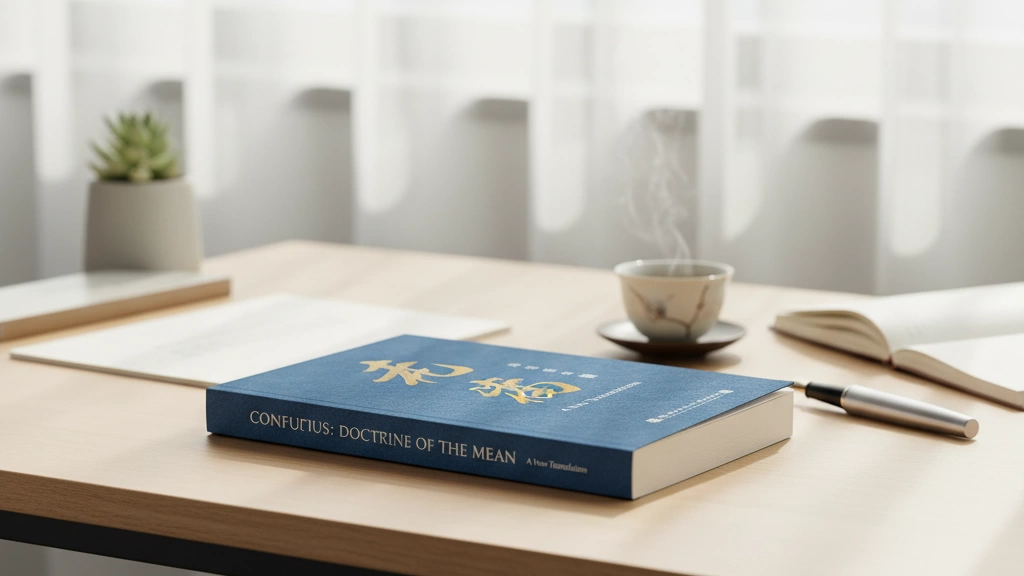
What Is the Doctrine of the Mean?
The Doctrine of the Mean is one of the core Confucius books (part of the Four Books of Confucianism). It’s a short classic that explains how to live with balance, clarity, and moral stability.
Instead of extreme behavior or rigid rules, it teaches a “middle way” that keeps your mind steady, your behavior measured, and your relationships healthy. In plain terms: it’s a Confucian guide to not overreact, not underreact, and stay grounded in who you are.
Balance and Moderation, Confucius-Style
The key Confucian idea here is “the mean” (zhongyong):
- Not average, but appropriate
- Not boring, but balanced and fitting to the situation
- Not emotionless, but stable and thoughtful
In daily life, that looks like:
- Not working 90 hours a week, but not slacking off either
- Not spoiling your kids, but not being cold and distant
- Not blowing up in anger, but not bottling everything up
The Doctrine of the Mean is Confucian philosophy in plain language: calm, steady, and focused on practical judgment.
Sincerity and Inner Harmony
One of the big ideas in this Confucius text is sincerity (cheng). It’s not just “being honest”; it’s being authentic and consistent from the inside out:
- Your values match your actions
- Your words match your intentions
- You act the same in private as you do in public
From a Confucian ethics and morality angle, real sincerity creates inner harmony:
- Less second-guessing yourself
- Less pretending to be someone you’re not
- More confidence in your choices, because they line up with your character
When you live this way, you’re not constantly pulled to extremes by moods, trends, or pressure from others.
How to Apply the Middle Way in Daily Choices
Here’s how you can apply the Doctrine of the Mean in normal, American day-to-day life:
1. Use “not too much, not too little” as a mental check.
Before you decide, ask:
- Am I overreacting or underreacting?
- What’s the balanced response here?
- What would a calm, steady version of me do?
2. In conversations and conflict:
- Don’t snap back, but don’t stay silent forever
- Speak clearly, but drop the drama
- Aim for firm, respectful, and measured, not passive or aggressive
3. With money and lifestyle:
- Spend, but don’t overspend
- Save, but don’t hoard
- Enjoy comfort, but don’t let consumption run your life
4. With social media and news:
- Stay informed, but don’t doomscroll
- Share opinions, but don’t live in outrage mode
- Set clear time limits and stick to them
This is Confucius for personal growth: small, calibrated moves instead of big swings.
Doctrine of the Mean for Stress and Work–Life Balance
For U.S. readers juggling work, kids, side hustles, and social life, the Doctrine of the Mean is surprisingly practical.
For work–life balance, try these Confucian-style moves:
-
Set a “mean” for your hours.
- Decide a realistic work range (for example, 8–9 hours a day, not 12–14)
- Treat extremes as exceptions, not the norm
-
Protect rituals that keep you centered.
- A real lunch break away from your laptop
- A short evening walk, reading time, or family dinner
- A weekly reset where you plan your schedule and cut out overload
-
Respond to stress with adjustment, not extremes.
- Instead of quitting or grinding harder, adjust: delegate, renegotiate deadlines, cut low-value tasks
- Ask: “What’s the balanced next step I can take today?”
-
Check in with yourself regularly.
- Morning or evening:
- What felt excessive today?
- What did I neglect that actually matters?
- Where can I move one notch closer to the middle?
- Morning or evening:
You see the spirit of the Doctrine of the Mean in how Confucius is honored in his hometown of Qufu today, where traditional Confucian culture, ritual, and daily life are held in careful balance at places like the Confucius Temple complex.
When you use this Confucius wisdom for daily life, you’re not chasing perfection. You’re building a steady, sustainable rhythm—a middle way that supports your health, your relationships, and your long-term goals.
Mencius: Developing Confucius’s Teachings
Who Was Mencius?
Mencius (Mengzi, 4th century BCE) was the most important Confucian thinker after Confucius.
He traveled from state to state, advising rulers and debating other philosophers, then became a key “second founder” of Confucianism.
Quick snapshot:
| Item | Mencius (Mengzi) |
|---|---|
| Era | Warring States period |
| Role | Confucian philosopher, teacher, advisor |
| Main Text | Mencius (one of the Four Books) |
| Focus | Human nature, moral politics, justice |
How Mencius Expanded Confucian Thought
Mencius didn’t just repeat Confucius; he pushed the ideas further:
- Turned Confucius’s ethics into a full system of moral psychology and political theory
- Argued that good government must serve the people, not just preserve order
- Used vivid stories and debates, making Confucian ideas sharper and easier to apply
If you’re into Confucian philosophy for self‑improvement and leadership, the Mencius gives you more detailed arguments than the short sayings in the Analects.
Innate Human Goodness vs. Human Nature Debates
One of Mencius’s most famous ideas: human nature is originally good.
He used simple images:
- Everyone would feel alarm if a child were about to fall into a well
- That feeling shows we all have “sprouts” of virtue:
- Compassion → benevolence (ren)
- Shame → righteousness (yi)
- Respect → propriety (li)
- Right/wrong sense → wisdom (zhi)
Key point:
We’re born with moral potential, but we must cultivate it through learning, reflection, and good environments.
This makes Mencius a powerful resource for moral education and personal growth.
Mencius on Rulers, Justice, and the People
Mencius is surprisingly bold—even by modern standards:
- The people’s well‑being comes first; rulers are there to serve them
- A ruler who ignores justice and virtue loses the “Mandate of Heaven”
- In extreme cases, removing a tyrant isn’t “killing a king” but removing a criminal
Core political ideas:
| Theme | Mencius’s View |
|---|---|
| Purpose of rule | Secure people’s livelihood and moral growth |
| Taxes & labor | Must be humane and not crush the poor |
| Justice | Based on morality, not just raw power |
| Legitimacy | Comes from virtue and support of the people |
For readers in the U.S., this makes Mencius feel close to constitutional ideas about legitimacy, justice, and the rights of the people—framed through Confucian ethics instead of Western law.
Differences Between Mencius and the Analects
Both are core Confucius books for beginners, but they read very differently:
| Feature | Analects of Confucius | Mencius |
|---|---|---|
| Style | Short sayings and brief dialogues | Longer debates, stories, and arguments |
| Focus | Personal virtue, daily conduct | Human nature, political philosophy, justice |
| Confucius himself | Central speaker | Quoted and expanded by Mencius |
| Reading feel | Compact, quote‑friendly | More like a conversation or case study book |
If you want:
- Quick wisdom and quotes → start with the Analects
- Deeper Confucian ethics and political thought → add the Mencius next
To see how these ideas played out where Confucius actually lived and taught, it’s worth exploring his hometown and its history in guides like this overview of Confucius and his legacy in Qufu.
Five Classics Confucius Book: What He Taught, Not Wrote

When people search “Confucius book,” they usually land on the Analects. But if you want to really understand Confucian thought and Chinese culture, you have to look at the Five Classics—the core books Confucius taught, even though he didn’t write most of them himself.
What Are the Five Classics?
In simple terms, the Five Classics of Confucius teachings are:
- Book of Poetry (Shijing) – 305 ancient poems and songs
- Book of Documents (Shangshu) – speeches, proclamations, early political writing
- Book of Rites (Liji) – rituals, etiquette, social roles, everyday behavior
- Book of Changes (Yijing / I Ching) – hexagrams, symbols, and change
- Spring and Autumn Annals (Chunqiu) – brief annual records of Confucius’s home state, Lu
These weren’t “Confucius books” in the sense that he sat down and wrote them. Instead, he:
- Preserved them
- Taught them as core curriculum
- Used them to shape his ethics, politics, and view of society
Think of the Five Classics as the Confucian “Old Testament” of Chinese thought.
How Confucius Used the Five Classics in Teaching
Confucius treated these books like a full training program for life:
-
Book of Poetry – To train empathy and feeling
- He used poems about love, work, war, and daily life
- He believed poetry softens the heart and sharpens judgment
-
Book of Documents – To teach leadership and good government
- He used stories and speeches from ancient rulers
- He pointed out what good rulers did right and bad rulers did wrong
-
Book of Rites – To shape behavior, manners, and social order
- How to act as a child, parent, friend, official
- Why ritual and respect (li) keep society stable
-
Book of Changes – To train decision-making and flexibility
- He studied how the world is always changing
- He focused on reflection and wisdom, not fortune-telling
-
Spring and Autumn Annals – To show history as a moral lesson
- Very short entries about events in the State of Lu
- Confucius read them as a subtle record of praise and blame
For him, these weren’t just “books to memorize.” They were tools for:
- Moral education
- Character building
- Learning how to live and lead
Why the Five Classics Matter for Confucianism
If you only read Confucius quotes or a quick Analects of Confucius , you get the tips but not the deep roots.
The Five Classics matter because they:
- Show where Confucian values come from
- Connect Confucian ethics to real history, real politics, and real families
- Explain why ritual, respect, music, law, and leadership are so central
- Help you see how Confucian thought shaped Chinese culture for 2,000+ years
For modern readers in the U.S., they’re useful if you:
- Work with East Asian partners, clients, or teams
- Want a deeper Chinese philosophy reading list
- Need a stronger handle on Confucian ethics and morality in real life
They turn “Confucius for personal growth” from casual quotes into a full worldview.
Which of the Five Classics to Read First (Beginner-Friendly Order)
If you’re just starting, you don’t need to read all five cover to cover. Here’s a realistic order for Confucius books for beginners in the U.S.:
-
Book of Poetry (Shijing) – Easiest entry
- Start with a short selected edition in English
- Look for versions with:
- Clear intros
- Notes explaining context
- Focus on:
- Love poems
- Work and farming poems
- Political criticism in coded language
- Great for empathy, emotional intelligence, and culture feel
-
Book of Documents (Shangshu) – For leadership and ethics
- Read selected speeches, not the whole thing
- Pay attention to:
- How ministers advise rulers
- How rulers are judged by virtue and justice
- Very useful if you’re into leadership, management, or public service
-
Book of Rites (Liji) – For behavior and social rules
- Don’t start with the entire book; it’s long
- Try:
- Excerpts on family rituals, mourning, respect
- Sections linked to Great Learning and Doctrine of the Mean
- Connects directly to Confucian ethics at work and in daily manners
-
Book of Changes (Yijing / I Ching) – For reflection, not fortune-telling
- Use a modern commentary that explains:
- Hexagrams
- Key ideas on change and timing
- Treat it as:
- A reflection tool for tough decisions
- A way to think about uncertainty and adaptation
- Use a modern commentary that explains:
-
Spring and Autumn Annals (Chunqiu) – Last, and only if you’re committed
- Very short and very dense
- Works best with a guide or commentary
- Good if you want to see how history becomes moral judgment
Quick Tips for U.S. Readers Choosing Five Classics Editions
When you pick English versions of these classic Chinese philosophy books, look for:
- Modern translations with:
- Clear notes
- Short introductions
- No heavy jargon
- Editions that connect:
- Confucian philosophy for self-improvement
- Confucianism and modern life (family, leadership, work)
If you’re building a Confucian classics reading order around the Five Classics, I’d pair them with:
- A beginner Confucius book (usually the Analects)
- A simple guide that explains Confucianism basic concepts like ren, li, and filial piety
From there, you’ll have a solid foundation to understand not just “what Confucius said,” but what he studied, taught, and built his entire philosophy on.
Book of Poetry: Emotion and Ethics in Ancient Odes
What is the Book of Poetry?
The Book of Poetry (also called the Book of Songs or Shijing) is one of the core Confucius books and one of the Five Classics. It’s a collection of about 300 poems from early China—folk songs, court hymns, and ritual odes—saved, taught, and praised by Confucius.
Think of it as:
- Part national songbook
- Part moral reader
- Part emotional diary of ancient life
For anyone exploring Confucianism basics, the Book of Poetry shows the human side: how ordinary people loved, worked, complained, and hoped.
Love, Labor, and Politics in the Poems
These poems aren’t dry philosophy. They’re short, direct, and surprisingly relatable:
-
Love and relationships
- Courtship songs, longing, heartbreak, jealousy
- Young women and men speaking in first person
- Simple images—boats, rivers, plants—to express desire and loss
-
Labor and everyday life
- Farming, weaving, hunting, gathering
- The grind of hard work and unfair taxes
- Songs workers might have actually sung in the fields
-
Politics and social criticism
- Complaint poems about bad rulers and corrupt officials
- Praise for just kings and good ministers
- Subtle protests wrapped in nature imagery so you could criticize safely
If you want to feel what early Chinese life was like—from the ground level—the Book of Poetry delivers it better than any history .
How Confucius Used Poetry to Teach Empathy
Confucius saw the Book of Poetry as a tool for moral education, not just literature:
- He used poems to train empathy—putting yourself in someone else’s shoes through their words.
- He believed that if you understand the emotions in these songs, you’ll treat others with more ren (benevolence) and respect.
- Poetry was also a safe way to talk politics: you could discuss a poem about a bad lord instead of openly attacking your own ruler.
For Confucius, reading poetry helped people:
- Soften their hearts
- Refine their taste
- Speak more carefully
- Sense right and wrong in real situations
If you ever visit Confucius’s hometown Qufu, you’ll see how central these classics were to education and culture there; the city’s history and temples reflect just how seriously people took these texts as moral training tools. A quick overview of Qufu history and culture gives helpful context for how the Book of Poetry fit into that world.
What Modern Readers Can Get from the Book of Poetry
If you’re in the U.S. looking for Confucius books for beginners, the Book of Poetry is a strong side-read if you like stories and feelings more than abstract theory.
You can use it for:
-
Emotional intelligence
- Notice subtle feelings in yourself and others
- See how people handle love, distance, pressure, and grief
- Practice reading between the lines
-
Ethics in real life
- Watch how unfair rulers are criticized through song
- See how loyalty and duty can clash with personal pain
- Reflect on justice, work, and power in your own workplace or community
-
Cultural understanding
- Get a feel for early Chinese values around family, marriage, and labor
- Spot roots of Confucian ethics in everyday situations, not just in rules
- Better understand East Asian literature, movies, and traditions that still echo these themes
How to read it today:
- Don’t binge it; read 2–3 poems at a time.
- Use a good English edition with short notes.
- Ask yourself:
- Who’s speaking?
- What are they feeling?
- What’s unfair or admirable here?
- Does anything feel like today—relationships, bosses, stress, money?
If you want Confucian wisdom wrapped in short, vivid scenes instead of lectures, the Book of Poetry is one of the best Confucius-related books to start with.
Book of Documents: Lessons from Ancient Rulers
What is the Book of Documents?
The Book of Documents (also called the Shujing or Classic of Documents) is one of the oldest Confucian classics. It’s a collection of:
- Political speeches
- Royal edicts and proclamations
- Historical records from early Chinese dynasties
Think of it as a mix of state of the union speeches, founding documents, and leadership case studies from ancient China. Confucius treated it as a core text for understanding how government should work and what “good rule” looks like in real life.
Political Speeches and Early Chinese History
Most chapters in the Book of Documents are framed as leaders speaking to:
- Their ministers
- Their heirs
- The people they govern
Through these speeches, we get a snapshot of early Chinese political thought and history—how rulers justified their power, handled crises, and talked about justice, taxes, war, and public order.
For anyone trying to understand the roots of Chinese culture and statecraft, this book sits right beside the land itself and cities like Confucius’s hometown of Qufu, where you can still see how his legacy shaped local culture and ritual life (Qufu culture and Confucian heritage).
Virtuous Leadership and Moral Rulership
At its core, the Book of Documents is about moral leadership. Again and again, it drives home that:
- Rulers hold power only if they care for the people.
- Legitimacy comes from virtue, not just force.
- A leader must be honest, self-disciplined, and responsible.
- Bad rulers lose what later thinkers called the “Mandate of Heaven”—their moral right to rule.
This kind of Confucian ethics still speaks clearly today: leadership is less about titles and more about character and accountability.
Why Leaders Still Read the Book of Documents Today
Modern readers—especially in leadership, public service, and business—still turn to the Book of Documents because it gives:
- Real leadership scenarios instead of abstract theory
- A long view on power, responsibility, and public trust
- Examples of both good and failed rulers, and what made the difference
- A steady reminder that ethical leadership outlasts short‑term wins
If you work in management, politics, education, or community organizing in the US, this classic can push you to:
- Reconsider how you use authority
- Clarify your values as a leader
- Build a culture that prizes integrity over quick gains
It’s ancient, but the questions it asks—Who deserves to lead? How should they lead? What do they owe their people?—are exactly the ones we’re still wrestling with today.
Book of Rites: Rituals and Everyday Behavior
What is the Book of Rites?
The Book of Rites (Liji) is one of the core Confucian classics. It’s not a “rule book” in the narrow sense, but a collection of texts about how people should live, act, and relate to each other.
It covers things like:
- How families should interact
- How rulers and ministers behave
- Proper conduct at ceremonies, meetings, and daily life
- The mindset behind good manners, not just the surface actions
If you’ve ever wondered why respect, politeness, and hierarchy feel so central in Chinese and East Asian culture, the Book of Rites is a big part of that story.
Rituals, Etiquette, and Social Roles
In Confucian thought, ritual (li) isn’t just about religious ceremonies. It’s about turning daily actions into habits of respect and care. That includes:
- Etiquette at home – how children speak to parents, how siblings treat each other
- Public manners – greetings, seating order, giving and receiving gifts
- Social roles – what’s expected from parents, children, friends, leaders, and followers
From a U.S. perspective, you can think of it as a deep-dive into “professionalism + family values + community norms” all in one. It’s about building trust and smooth cooperation through clear, respectful behavior.
Roots of Great Learning and Doctrine of the Mean
Two other key Confucian texts, Great Learning and Doctrine of the Mean, originally came from chapters within the Book of Rites.
That means:
- The Book of Rites is the source of many big Confucian ideas on self-improvement, balance, and leadership.
- When you study those shorter works, you’re really getting distilled lessons from a much larger tradition rooted in the Book of Rites.
If you ever travel to Confucius’s hometown of Qufu and walk through the temples and academies, you’ll see how these ritual ideas were actually lived out in real spaces and ceremonies. Planning that kind of trip is easier when you understand the role of ritual, and resources like local Qufu transportation guides can help you connect the text to real places.
How Confucian Ritual Shapes Manners and Respect
Confucian ritual isn’t about being stiff or fake. It’s about using outer behavior to train inner character. A few key takeaways for daily life in the U.S.:
-
Ritual builds respect
Repeated, intentional actions—like standing to greet someone, putting your phone away at dinner, or letting others speak first—train us to value people, not just tasks. -
Clear roles reduce conflict
When everyone knows their responsibilities (manager vs. team member, parent vs. child, host vs. guest), there’s less friction and more trust. -
Small habits, big impact
Confucius saw everyday gestures—saying “thank you,” keeping promises, dressing appropriately—as training for bigger moral decisions later. -
Work and family benefit
In a U.S. office, “ritual” shows up in on-time meetings, respectful feedback, and how leaders recognize their teams. At home, it’s family dinners, shared routines, and how we show care for parents and kids.
If you’re looking to understand why respect, hierarchy, and politeness are so central when you visit Confucian sites or talk with people from Confucian-influenced cultures, the Book of Rites gives you the blueprint. It explains not just what people do, but why ritual and manners still matter for social harmony today.
Book of Changes: Confucius and the Yijing
What is the Book of Changes (Yijing)?
When people talk about a “Confucius book” beyond the Analects, the Book of Changes (Yijing or I Ching) always comes up. It’s one of the Five Classics of Confucius teachings and one of the most important books in Chinese philosophy.
In plain terms, the Yijing is:
- A classic text built around 64 hexagrams (six-line symbols made of broken and solid lines)
- A guide to how change works in life, nature, politics, and personal decisions
- A book Confucian thinkers used for moral reflection, not just prediction
For U.S. readers, think of it as a mix of a decision-making framework, a self-reflection tool, and a philosophy of constant change, all in one.
Hexagrams, change, and decision making
Each hexagram is a pattern of six lines:
- Solid line (—) = active, firm, “yang”
- Broken line (- -) = receptive, yielding, “yin”
These lines form 64 possible patterns. Each pattern comes with:
- A name (like “Peace,” “Difficulty at the Beginning,” “Waiting”)
- A short judgment text
- Line statements that describe different stages of a situation
Used well, the hexagrams help you:
- See where you are in a cycle of change
- Spot risks and opportunities before acting
- Think through timing: when to push, when to wait
- Make decisions with more awareness and humility
For example, a manager in the U.S. might use the Yijing to reflect on:
- Whether to launch a product now or later
- How to respond to a conflict at work
- When to press for change versus when to stabilize the team
You’re not looking for magic answers. You’re using structured symbols and texts to think more clearly.
Confucian commentary on the Yijing
Confucius didn’t write the original core of the Yijing, but later tradition links him and early Confucians to key commentaries called the “Ten Wings.” These turned the Book of Changes into a major Confucian philosophy text.
Confucian readings of the Yijing focus on:
- Moral character: how a virtuous person responds to changing situations
- Responsibility: rulers and leaders must read “signs” to serve the people
- Self-cultivation: change outside starts with change inside
- Order and harmony: even chaos has patterns you can learn from
This is where Confucian ethics and morality meet the idea of change. Instead of “how do I get what I want,” the question becomes:
“What is the right way to act in this changing situation so that I stay in line with virtue?”
For U.S. readers in leadership, management, or public service, this Confucian lens makes the Yijing less mystical and more like a moral decision-making manual.
Using the Book of Changes for reflection, not fortune telling
A lot of people in the West only know the Yijing as a fortune-telling book. If you’re coming from a U.S. background and want Confucius philosophy in plain language, here’s how I suggest you use it instead:
Use it as a reflection tool:
- Treat each hexagram as a mirror, not a prediction
- Read a hexagram and ask:
- “Where does this show up in my life right now?”
- “What habits or blind spots is this pointing out?”
- Use it to think about character, timing, and consequences
Practical ways to use it:
-
Journaling with Confucius-style questions
- What’s changing in my work or family right now?
- Am I pushing too hard, or not enough?
- What would a virtuous leader do here?
-
Decision check-in
- Before a big move (job change, investment, partnership), read a hexagram
- Use the text as a prompt to test your assumptions and stress-test your plan
-
Team or family reflection
- Read a passage together (in a modern English version)
- Talk about which lines fit your current situation
- Focus on learning and awareness, not superstition
What to avoid:
- Don’t use it as a yes/no oracle
- Don’t treat it like a lottery ticket for answers
- Don’t skip the moral side—Confucian thought always ties back to virtue, duty, and relationships
When you approach the Book of Changes as a Confucius-adjacent wisdom text—not a fortune machine—it becomes a sharp tool for:
- Better judgment
- Calmer thinking under stress
- Long-term personal growth
For U.S. readers who care about self-improvement, leadership, and thoughtful decision making, the Yijing can be one of the most powerful “Confucius books” you add to your reading list, especially when you read it with a Confucian, ethical mindset.
Spring and Autumn Annals: History as Moral Lesson
What is the Spring and Autumn Annals?
When people ask about a core Confucius book, the “Spring and Autumn Annals” (Chunqiu) always shows up on the list. It’s a very short historical record, traditionally linked to Confucius, that covers about 240 years of the State of Lu’s history.
- It looks like a simple timeline: dates, events, names.
- But in Confucian thought, it’s not just history—it’s a moral judgment on history.
- Every word choice, what’s included, and what’s left out is treated as meaningful.
For readers in the U.S., you can think of it like a mix between a timeline and an editorial: it records events but quietly “rates” them using careful, neutral‑sounding language.
The State of Lu and Confucius’s Homeland
The State of Lu was Confucius’s home, in what is now Shandong Province in eastern China. That matters for a few reasons:
- Lu is where Confucius lived, taught, and tried to advise rulers.
- The Spring and Autumn Annals covers Lu’s wars, alliances, rituals, and political scandals.
- Many later Confucian thinkers believed Confucius edited or shaped this history to send a moral message to future rulers.
So when we read this Confucius book, we’re not just reading “China’s past”—we’re seeing how Confucius viewed his own society, its failures, and its potential.
How Brief Records Carry Moral Judgment
At first glance, the Spring and Autumn Annals looks dry: short lines like “In the third year, in spring, such-and-such lord attacked such-and-such state.” But in Confucian reading, those brief notes carry moral weight:
- Title choice: Calling someone “Duke” or just using a name can signal respect—or a quiet critique.
- Verb choice: Saying a ruler “invaded” rather than “assisted” hints at right vs. wrong.
- Mention or silence: Some events are recorded in detail, others barely show up. That contrast is a moral signal.
This Confucian classic trains you to see that:
- Language can judge behavior without loud criticism.
- History can guide ethics by rewarding virtue and exposing wrongdoing.
If you work in leadership or policy in the U.S., this is a powerful idea: the way we write reports, memos, and news also shapes what people see as normal, acceptable, or shameful.
Why This Classic is Harder but Still Important
I’ll be honest: if you’re looking for Confucius books for beginners, the Spring and Autumn Annals is not the first stop. It’s tough for a few reasons:
- The writing is extremely short and compressed.
- You need background on the states, rulers, and wars to fully get the point.
- The moral judgments are hidden in wording, so you usually need commentary.
But it’s still worth knowing about—and eventually reading—because:
- It shows how Confucian ethics and morality play out in real politics, not just in quotes.
- It’s a key part of the Confucian classics reading order for anyone serious about Chinese philosophy.
- It teaches a “slow reading” habit that’s useful for business, law, and leadership:
- Notice small word choices.
- Ask what’s being praised or criticized.
- Think about how you record events in your own work and life.
If you live in the U.S. and you’re interested in:
- Confucian thought and Chinese culture,
- ethics in government or corporate leadership, or
- how history can act as a moral mirror,
then the Spring and Autumn Annals is a tougher Confucius book, but it’s an important one to at least understand—and eventually tackle with a good commentary or study guide.
Best Confucius Books for Beginners
If you’re new to Confucius and just want a clear, practical starting point, here’s the Confucius book list I recommend for most U.S. readers. All of these are easy to use for self‑study, students, and families.
Must‑Read Confucius Book List for New Readers
If you only start with a few, start here:
-
Analects of Confucius – translated by Edward Slingerland
- Clear modern English, great notes, beginner‑friendly.
- Focuses on Confucius quotes about learning, leadership, and character.
- Good balance of readability and accuracy.
-
The Analects – translated by D.C. Lau
- Short, simple, and affordable.
- Great if you want a plain, no‑nonsense Analects of Confucius feel.
-
The Essential Confucius (edited/translated by Burton Watson)
- Selected passages from the Analects, Mencius, and other classics.
- Perfect if you want the “big ideas” of Confucian philosophy for self improvement without reading everything.
-
Mencius – translated by D.C. Lau
- Best next step after the Analects.
- Shows how Mencius and Confucius are connected, especially on innate human goodness and moral leadership.
Simple Confucius Books for Self‑Study
If you’re reading on your own and don’t want to get lost in academic detail:
-
“The Path: What Chinese Philosophers Can Teach Us About the Good Life” (Michael Puett & Christine Gross‑Loh)
- Modern, story‑driven intro to Confucianism and modern life.
- Great for U.S. readers who want Confucius for personal growth, not just history.
-
“Confucius: A Very Short Introduction” (Daniel K. Gardner)
- Brief, clear, and practical.
- Good background on Confucian thought and Chinese culture in under 200 pages.
-
“The Wisdom of Confucius” (public domain collections)
- Free public domain Confucius texts (often Analects selections).
- Works well if you’re testing the waters before buying a full edition.
Self‑study tips:
- Read 10–15 minutes a day instead of trying to binge.
- Keep a notebook for:
- Confucius quotes about learning
- Confucius teachings on virtue, ren, and li
- One line on how you’ll apply each quote today.
Confucius Books for Students and Classrooms
For middle school, high school, or college in the U.S., you want short, clear, and classroom‑friendly:
-
“The Analects of Confucius: A Philosophical Translation” (Roger T. Ames & Henry Rosemont Jr.)
- Great for classes on Chinese philosophy reading lists.
- Strong on Confucian ethics and morality, ren and li, and cultural context.
-
Hackett or Oxford World’s Classics editions of the Analects
- Designed for students:
- Helpful intros
- Notes on key ideas like filial piety, ritual (li), leadership, and the Golden Rule.
- Good for Confucius study guides for students.
- Designed for students:
-
“Readings in Classical Chinese Philosophy” (edited by Ivanhoe & Van Norden)
- Includes core texts from Confucius, Mencius, and others.
- Works well for intro philosophy or world history courses.
Classrooms in the U.S. usually want:
- Short assigned passages
- Plain language explanations
- Direct links to:
- Ethics at work and in leadership
- Respect and family relationships
- Civic values and responsibility
These editions make that easy.
Family‑Friendly Confucius Books and Children’s Editions
If you want to introduce Confucius wisdom for daily life at home:
-
“Confucius: The Golden Rule” (Russell Freedman)
- Illustrated biography for kids.
- Simple stories showing Confucius teachings on respect, kindness, and learning.
-
Children’s “Sayings of Confucius” picture books
- Short Confucius sayings and aphorisms with art and kid‑level language.
- Great for bedtime reading or quick family talks about character.
-
Simplified Analects for young readers (various publishers)
- Shortened, explained versions of the Analects of Confucius.
- Focus on:
- Respect for parents (filial piety)
- Honesty
- Hard work and learning
- Treating others kindly (Confucius and the Golden Rule)
How U.S. families use these:
- Read one quote a night, then ask:
- “What does this mean in your own words?”
- “Where did you see this happen at school or work today?”
- Post favorite Confucius quotes about leadership, respect, and learning on the fridge or in a common area.
Bottom line:
If you’re just starting, pick one Analects translation, one simple intro book, and, if you have kids, one children’s Confucius book. That’s enough to build a solid base in Confucianism basic concepts without getting overwhelmed.
Best Analects of Confucius Book: Translations That Actually Work

When you’re picking a Confucius book—especially the Analects of Confucius—the translation makes or breaks the experience. In the U.S., most readers want something clear, accurate, and not overloaded with jargon. Here’s how I look at it.
What to Look for in an Analects Translation
When I choose an Analects of Confucius translation, I check for:
- Plain, modern English
- No fake “ancient-sounding” language
- Sentences you can actually quote and use in daily life
- Clear notes, light touch
- Short footnotes that explain people, places, and key terms like ren (benevolence) and li (ritual/propriety)
- No 20-page detours every time Confucius opens his mouth
- Stable key concepts
- Terms like ren, li, junzi (noble person), xiao (filial piety) translated consistently
- Good intro, not a textbook
- A brief overview of Confucian philosophy, the Four Books, and how the Analects fits into classic Chinese philosophy
- Readable format
- Numbered passages, clear section headings, room to highlight and take notes
- Credible translator
- Background in Chinese philosophy or sinology
- Ideally cross-checked with other major editions
Beginner-Friendly Analects of Confucius Translations
If you’re just starting with Confucius books for beginners, these work best for most U.S. readers:
-
D.C. Lau – “The Analects” (Penguin Classics)
- Why it’s good: Straightforward, clean English, solid notes
- Best for: First-time readers, students, book clubs
-
Edward Slingerland – “Confucius: Analects” (Hackett)
- Why it’s good: Very clear translation, great intro, solid on context
- Best for: Anyone who wants something modern but serious
-
Burton Watson – “The Analects of Confucius”
- Why it’s good: Smooth, readable, feels natural in English
- Best for: People who want Confucius philosophy in plain language
If you’re in the U.S. and reading for personal growth, leadership, or everyday ethics, I’d start with Lau or Slingerland. They hit a sweet spot between accessible and reliable.
More Scholarly Analects Editions
If you want to go deeper into Confucian thought and you’re okay with more notes and technical detail, these scholarly Analects editions are strong:
-
Ames & Rosemont – “The Analects of Confucius: A Philosophical Translation”
- Focuses on Confucian ethics, relationships, and social roles
- Heavy on interpretation; helps you see Confucius as a live philosophy, not a museum piece
-
E. Bruce Brooks & A. Taeko Brooks – “The Original Analects”
- Tries to reconstruct the historical layers of the text
- Better if you already know the basic Analects of Confucius
-
Roger T. Ames (editions with commentary)
- Strong if you’re comparing Confucianism and Western ethics or Greek philosophy
- Good for serious students, grad-level work, and deep study
These are ideal if you’re using Confucius for leadership training, academic work, or want to understand how concepts like ren and li in Confucianism evolved.
Free Public Domain Confucius Books Online
If you just want to test the waters or need a Confucius study guide on a budget, there are public domain Confucius texts online:
-
James Legge – “The Chinese Classics: The Analects”
- Available free on:
- Internet Archive
- Project Gutenberg
- Various university sites
- Older, Victorian English, but still useful for reference
- Available free on:
-
Other public domain Confucian classics English versions you can usually find free:
- Mencius (Legge translation)
- Doctrine of the Mean and Great Learning
- Parts of the Book of Rites, Book of Documents, Book of Changes, and Spring and Autumn Annals
How I suggest using these free versions:
- Use them as:
- A backup reference
- A way to compare how key ideas like filial piety, Confucian morality, and the Golden Rule get translated
- But for your first serious read, I strongly recommend a more modern translation like Lau, Slingerland, or Watson. It will save you a lot of frustration.
Quick Recap: How to Pick Your Analects of Confucius Book
- If you’re a beginner:
- Start with D.C. Lau or Edward Slingerland
- If you want depth and theory:
- Add Ames & Rosemont or another scholarly edition
- If you want free access:
- Grab James Legge online and treat it as a secondary reference
Choosing the right Confucius book up front makes Confucian philosophy for self‑improvement, leadership, and everyday life a lot more usable—and a lot less confusing.
How to Choose Your First Confucius Book
Picking your first Confucius book matters. If you match the text to your own goals and reading style, you’re way more likely to finish it and actually use what you learn in real life.
Match Your Goals to the Right Confucius Text
Start by asking: Why am I reading Confucius in the first place?
Use this quick guide:
| Your Goal | Best First Confucius Book | Why It Fits |
|---|---|---|
| I want simple, direct wisdom for life | Analects of Confucius (good modern translation) | Short sayings, clear Confucius quotes, easy to apply |
| I want personal growth & self‑improvement | Great Learning + selected Analects passages | Focuses on self-cultivation and moral growth |
| I want to understand Chinese culture & history | Analects + a short intro book on Confucianism | Core Confucian philosophy + cultural context |
| I’m a student or lifelong learner | Analects (annotated edition) | Notes, intro essays, and study tools included |
| I’m into leadership & ethics | Analects + Mencius (selections) | Strong on virtue, leadership, and responsibility |
| I want something very short | Great Learning or Doctrine of the Mean (simplified) | Compact but powerful Confucius texts |
If you’re not sure, start with a beginner‑friendly Analects of Confucius. It’s still the main Confucius book for English readers and the best entry point.
Confucius Reading Paths for Beginners
You don’t need to read everything at once. Build a simple path that fits your time and attention.
Path 1: Super Simple (Busy Schedule)
- Step 1: Read a short selection of Analects quotes (15–20 pages)
- Step 2: Pick 1–2 quotes a week to reflect on
- Step 3: Keep a small notebook for quick thoughts
Path 2: Core Confucius Books (Most People)
- Analects of Confucius (modern translation)
- Great Learning (for personal growth)
- Doctrine of the Mean (for balance and mindset)
Path 3: Deeper Confucianism (If You’re Curious)
- Analects → Great Learning → Doctrine of the Mean → Mencius (selections)
- Then sample the Five Classics if you want more history and culture
Stay practical: it’s better to really learn one Confucius book than skim five.
How Much Background You Really Need
You don’t need a degree in Chinese history to start.
For most U.S. readers, this is enough:
- A short intro (10–20 pages) on:
- Who Confucius was
- The idea of ren (humaneness) and li (ritual/propriety)
- Basic Warring States / early China timeline
- A translation with:
- Short notes
- Clear, plain English
- Helpful section headings
What you don’t need at the beginning:
- Deep philology or character-by-character analysis
- Long academic debates about dating or authorship
- Full commentaries from every dynasty
If you can follow a well-edited classic like Marcus Aurelius or Plato in English, you have more than enough background to read Confucius in a good modern translation.
Print vs Digital vs Audio Confucius Books
Pick the format that matches how you actually read, not what sounds “ideal.”
| Format | Best For | Pros | Cons |
|---|---|---|---|
| Deep focus, note‑taking | Easy to underline, flip, and see structure | Less portable, you need to carry it | |
| Digital (Kindle, tablet, phone) | Commuters, travelers, quick access | Searchable, highlight, sync notes | Easy to get distracted by other apps |
| Audio | Driving, walking, workouts | Great for hearing Confucius sayings repeatedly | Harder to pause, reread, and take notes |
How I’d set it up for most U.S. readers:
-
Step 1 (Audio or Digital):
Listen to or skim a modern Analects of Confucius or a short selection of Confucius quotes. Get familiar with the voice and style. -
Step 2 (Print or Focused Digital):
Buy a print copy of a good Analects translation for real study:- Read 1–3 short passages a day
- Mark what hits you
- Write 1–2 lines about how it relates to your life
-
Step 3 (Optional Audio):
Use an audio Confucius book in the background to reinforce key lines while driving, during walks, or at the gym.
Bottom line:
- If you want serious study → go print (or e‑ink + heavy highlighting).
- If you want exposure and repetition → add audio.
- If you want flexibility → keep a digital copy on your phone for spare moments.
Choose the format that you’ll actually use every week. That alone will make your first Confucius book pay off.
How to Study Confucius on Your Own
If you’re in the U.S. and want a simple, real-life way to study Confucius on your own, you don’t need a degree in Chinese philosophy. You just need a light routine, a notebook, and maybe a friend or two who’s curious about the same things.
Below is a practical, no-nonsense guide you can actually follow.
Simple Confucius Study Routine
Keep it small, steady, and realistic. Think “daily habit,” not “big project.”
Here’s a simple weekly Confucius study routine:
-
Daily (10–15 minutes):
- Read 1–3 short sayings from the Analects of Confucius.
- Underline or highlight one line that hits you.
- Write 2–3 sentences on:
- What Confucius is saying
- How it connects to something in your life (family, work, school, leadership, etc.)
-
Once a week (20–30 minutes):
- Re-read your favorite quotes from the week.
- Pick one idea to focus on for the next week:
- “Be more patient with family.”
- “Listen more at work before I speak.”
- “Ask better questions instead of pretending I know it all.”
-
Once a month (30–45 minutes):
- Look back through your notes.
- Ask yourself:
- What habits have actually changed?
- Which Confucius teachings feel most useful for me right now?
- Where am I still stuck?
Some simple tips that work well for U.S. readers:
- Use a readable translation of the Analects (not super academic).
- Read in short bursts: before work, during lunch, or at night instead of endless scrolling.
- Don’t rush. Confucius is better in small doses than a long cram session.
Journaling With Confucius Quotes
Journaling is one of the best ways to make Confucian philosophy stick and actually help with self-improvement.
Try this simple “Confucius quote journal” format:
-
Step 1 – Write the quote:
- Example: “To learn and at due times to repeat what one has learned, is that not after all a pleasure?”
-
Step 2 – Put it in your own words:
- “It feels good to learn something and actually review it so it stays with me.”
-
Step 3 – Connect it to your life:
- “This fits my work. I learn new tools but rarely review them, so I forget. I should set a weekly review time.”
-
Step 4 – Set one tiny action:
- “Every Friday, I’ll review one thing I learned that week for 10 minutes.”
You can also journal by theme:
- Confucius quotes about learning:
- How do I learn? Do I really listen? Do I review?
- Confucius quotes about leadership:
- If I manage people or lead a team, do I lead by example, or just by orders?
- Confucius quotes about family and respect:
- How am I showing respect at home? Where can I be more present?
Tools that work well in the U.S. context:
- Notes app on your phone for quick thoughts.
- Google Docs or Notion for a more organized Confucius study guide.
- A small paper notebook if you prefer handwriting to slow down and think.
Reading Confucius With Friends or Book Clubs
Confucius was a teacher who talked with students. His ideas work even better in a group.
If you’re in a book club or want to start a small one, here’s a simple structure:
-
Group size:
- 3–8 people is perfect. Small enough for everyone to talk.
-
Meeting plan (60–90 minutes):
- 10 minutes – Quick check-in:
- One Confucius quote that stood out this week.
- 40–60 minutes – Discussion:
- Go through 5–10 short passages from the Analects or another Confucius book.
- For each passage, ask:
- What is Confucius really saying here?
- How would this apply in modern American life?
- Does this fit with our ideas of success, leadership, or family?
- 10–15 minutes – Takeaways:
- Each person shares one practical action for the week.
- 10 minutes – Quick check-in:
-
Easy topics for a Confucius book club:
- Confucius and leadership at work
- Confucius and parenting / family relationships
- Confucius and personal growth and self-discipline
- Confucius and ethics in business or public life
You can run this in:
- Local community centers or libraries
- Workplace lunch groups
- Online meetups (Zoom, Discord, etc.)
The key: keep it concrete. Always bring the conversation back to “What would this look like in our real lives here and now?”
Common Questions New Readers Have About Confucius
If you’re just starting out, you’re probably asking the same things most U.S. readers ask. Here are quick answers.
- Do I need to know Chinese history to read Confucius?
- No. It helps, but it’s not required.
- All you really need at first:
- Confucius was a teacher in ancient China.
- He cared about virtue, learning, and social harmony.
- A short introduction or preface in a good edition will give you enough background.
- Is Confucianism a religion?
- It’s more of a moral and social philosophy.
- People use it alongside different religions or no religion at all.
- You can read Confucius like you’d read Greek philosophy or modern self-improvement books—focused on character, behavior, and ethics.
- Why does he talk so much about “filial piety” and family?
- In Confucius’s view, family is where we first learn respect, responsibility, and care.
- For modern readers:
- It can mean honoring your parents and elders.
- It can also mean showing up for your family, being reliable, and treating relatives with basic respect—even when you disagree.
- His ideas feel old-fashioned. Are they still useful in modern American life?
- Many are surprisingly timeless:
- Learning and reviewing what you learn
- Leading by example, not by fear
- Treating others how you’d like to be treated (his version of the Golden Rule)
- Controlling yourself before trying to control others
- The details of ancient rituals might feel distant, but the core values—honesty, respect, responsibility, humility—still matter in school, work, and family life.
- How much should I read at a time?
- Less than you think.
- 5–10 minutes a day is enough to start.
- One short passage you really understand is better than 20 pages you forget.
- Which Confucius book should I start with?
- Most beginners start with:
- The Analects of Confucius (short sayings and conversations).
- Keep it simple:
- Pick a clear, modern English translation.
- Add a notebook and a small daily reading habit.
If you treat Confucius as a guide for daily life—not a distant, untouchable figure—you’ll get a lot more out of every page. The goal isn’t to memorize old sayings; it’s to quietly upgrade how you think, how you act, and how you treat people, one short quote at a time.
Confucius Quotes Everyone Should Know
When people search for a “Confucius book,” what they really want most of the time is his core wisdom in short, clear lines. Here are the Confucius quotes I come back to the most, plus how to actually use them in daily life.
Most Famous Confucius Quotes
1. “Isn’t it a pleasure to study and practice what you have learned?”
Use it as: A reminder that learning isn’t a chore; it’s a long‑term advantage.
2. “To see what is right and not do it is a lack of courage.”
Use it as: A check on your behavior when you stay silent about something wrong at work or in your community.
3. “When you see a worthy person, think of becoming their equal. When you see an unworthy person, examine yourself.”
Use it as: A way to stop judging and start improving yourself.
Confucius Quotes on Learning and Education
These are perfect if you’re in school, building a career, or working on self‑improvement:
-
“If I walk with two other people, each of them will be my teacher.”
→ Treat everyone as a source of learning—boss, intern, customer, even critic. -
“Learning without thinking is useless. Thinking without learning is dangerous.”
→ Don’t just collect content. Reflect, question, and apply it. -
“He who learns but does not review is like one who forgets.”
→ Simple habit: review your notes, key ideas, or wins at the end of the day. -
“Real knowledge is to know the extent of one’s ignorance.”
→ Stay curious, admit what you don’t know, and you’ll grow faster.
Confucius Quotes on Respect and Family
Confucius put family and respect (especially filial piety) at the center of a good life:
-
“Filial piety and brotherly respect are the roots of human goodness.”
→ How you treat parents, kids, and siblings shapes your character. -
“In serving your parents, gently remonstrate; if they do not listen, remain respectful.”
→ Disagree without contempt—important for adult kids and aging parents. -
“The noble person is cautious in speech and quick in action.”
→ Less arguing, more doing—especially at home. -
“Harmony is to be cherished.”
→ Not fake peace, but working through conflict with respect.
Confucius Quotes on Leadership and Character
These work well for managers, business owners, teachers, and parents:
-
“If the ruler is upright, all will go well without orders; if he is not upright, even if he gives orders, they will not be obeyed.”
→ Your example matters more than your job title. -
“Guide them with virtue, keep them in line with ritual, and they will have a sense of shame and also correct themselves.”
→ Lead with values and culture, not just rules and punishment. -
“The noble person is not a vessel.”
→ Don’t be just a tool or a job description. Build broad character, not just skills. -
“The noble person seeks it in himself; the small person seeks it in others.”
→ Take responsibility first before blaming. -
“Do not impose on others what you yourself do not desire.” (Confucius’s Golden Rule)
→ In hiring, feedback, or negotiations, ask: Would I want to be treated this way?
How to Bring Confucius Quotes Into Daily Life
You don’t need a full Confucius book to get value. Use the quotes like a daily toolkit:
1. Turn quotes into daily prompts
- Pick one quote per week and write it on:
- A sticky note on your monitor
- The lock screen of your phone
- The top of your planner or digital to‑do list
- Each night, ask: “Where did I follow this today? Where did I miss it?”
2. Use them as decision filters
Before a tough call at work or home, run through three quick questions:
- Is this aligned with virtue? (Am I being honest and fair?)
- Am I treating others how I’d want to be treated?
- Am I setting the example I’d want others to copy?
3. Bring quotes into family and team conversations
- Start a weekly family dinner or team meeting with:
- One Confucius quote on learning, respect, or character
- One real situation and ask, “How would this apply here?”
- This builds a shared language around values without sounding preachy.
4. Use quotes for self‑check in conflict
When you’re angry or frustrated:
- Remember: “The noble person is cautious in speech.”
- Pause 10 seconds before replying to that email, text, or comment.
- Ask: Am I acting like the “noble person” here, or just reacting?
5. Build a simple Confucius quote journal
- Each day or week, write:
- One quote
- One area of your life it connects to (work, family, money, health)
- One small action you’ll take based on it
- Over time, this becomes your personal “Confucius book” for your own life.
If you’re in the U.S. and just getting started, these quotes are an easy, low‑pressure entry into Confucian philosophy for self‑improvement, leadership, and better relationships—without needing any background in Chinese history or classical texts.
Confucius Books in Modern Life

Confucius might feel ancient, but his ideas plug straight into how we work, lead, and live in the U.S. today. When I recommend a Confucius book, I’m usually thinking about three things: personal growth, leadership, and cross‑cultural understanding.
Confucius for Personal Development
Confucian philosophy is basically a long-term personal development plan.
Key ideas you can use right away:
- Daily self-check – Confucius pushes constant self-reflection:
- Did I keep my word?
- Did I treat people with respect?
- Did I learn something new?
- Lifelong learning – “If I walk with two others, each can be my teacher.”
- Treat coworkers, family, even strangers as sources of insight.
- Short daily reads from the Analects of Confucius work better than binge-reading.
- Character over image – Focus on virtue, not appearance:
- Do the right thing even when nobody’s watching.
- Build a reputation on consistency, not self-promotion.
If you’re into self-improvement, journaling, or habit-building, Confucius books give you simple, repeatable principles instead of hype.
Confucius and Modern Leadership Training
A lot of leadership workshops and MBA programs quietly borrow from Confucian ethics without saying so.
Confucius’s leadership mindset in plain terms:
- Lead by example – A leader’s character sets the tone.
- You want people to be honest? Be brutally honest yourself.
- You want respect? Start by showing it down the org chart.
- Influence > authority – Confucius favors moral authority over fear:
- Win trust so people want to follow, not because they have to.
- Care for your people – “The people are the foundation.”
- Know your team, protect them when things go wrong, give them credit when things go right.
If you manage a team, run a small business, or lead a project, reading the Analects of Confucius or Mencius gives you a solid ethical framework that fits right into modern leadership training.
Confucian Ethics at Work and in Business
Confucian ethics plug in cleanly to U.S. workplace issues: trust, fairness, and long-term relationships.
Core Confucian values you can apply at work:
- Ren (benevolence / human-heartedness)
- Treat coworkers as people, not tools.
- Build a culture where helping each other is normal, not “extra.”
- Li (rituals, respect, good manners)
- Be on time, follow through, answer clearly, listen fully.
- Use small “rituals” (weekly check-ins, thank-you notes, debriefs) to show respect.
- Filial piety, adapted
- In a company, this can mean respecting mentors, honoring those who trained you, and not throwing previous teams under the bus.
For U.S. professionals, Confucius is useful if you care about:
- Long-term business relationships, not quick wins
- Reputation and trust in your brand
- Ethical decision making when there’s no clear rulebook
Using Confucius to Understand East Asian Culture
If you work with Chinese, Korean, Japanese, or broader East Asian partners, Confucian thought is a cheat sheet for understanding what’s going on under the surface.
Confucius books help explain:
- Respect for hierarchy – Why titles, age, and roles matter in meetings
- Indirect communication – Why people might avoid open confrontation or saying “no” directly
- Family and duty first – Why family obligations are taken extremely seriously
- Face and reputation – Why public criticism can be far more damaging than it looks from a U.S. lens
Reading the Analects of Confucius or short summaries of the Four Books and Five Classics gives you:
- Better cross-cultural negotiation skills
- Fewer misunderstandings in East–West teamwork
- A clearer sense of how values, not just laws, shape behavior in East Asia
If you’re in the U.S. looking for Confucius books for beginners, I’d start with a good, readable Analects of Confucius translation and treat it like a practical playbook for character, leadership, and working well with others in a global, East Asia–connected world.
Comparing Confucius Book Ideas to Other Traditions
When I look at a classic Confucius book like the Analects, I see it fits right in with the big names of world philosophy—just from a very different angle. If you’re used to Greek or Western ethics, here’s how Confucian philosophy lines up.
Confucius and Greek Philosophy Parallels
Confucius has a lot in common with Greek thinkers you probably know from school:
-
Like Socrates
- Confucius teaches mainly through short conversations and questions.
- He doesn’t give a strict system; he guides students to think for themselves.
- Both care more about how to live than about abstract theory.
-
Like Aristotle
- Focus on virtue and character, not just rules.
- Belief that good habits and training shape who you become.
- Strong interest in how to become a good person and a good citizen.
-
Key differences
- Greek philosophy often chases big questions about truth, logic, and the universe.
- Confucius stays closer to daily life: family, work, manners, leadership, and social harmony.
- He’s less about “What is reality?” and more about “How should I act today?”
If you’re a fan of Plato or Aristotle, the Analects of Confucius will feel like practical, real-world ethics instead of classroom theory.
Confucius and Western Ethics
Confucius lines up with a lot of Western ethics, but with a twist:
-
Similar to virtue ethics
- Emphasis on virtue, habit, character, and self‑cultivation.
- You become good by doing good, over and over, in real relationships.
-
Different from rule‑based ethics
- Western ethics often focuses on clear rules: right vs. wrong, laws, rights.
- Confucius cares more about relationships than rules:
- Parent–child
- Ruler–people
- Teacher–student
- Friend–friend
-
Respect and responsibility
- Heavy focus on filial piety, respect for elders, and loyalty.
- Morality isn’t just personal; it’s social. Your character shows in how you treat others, especially family.
If you’re into personal development, leadership, or workplace culture in the U.S., Confucian ethics works well as a relationship‑first, character‑first approach.
How Confucianism Differs from Religion
A lot of people in the U.S. ask if Confucianism is a religion. It depends how you define “religion,” but here’s how I frame it:
-
What it is not
- No single God you must worship.
- No strict doctrine of salvation, heaven/hell, or sin like in Christianity or Islam.
- No demand to “believe” in unseen truths to be a Confucian.
-
What it is
- A moral and social philosophy built around:
- Virtue
- Respect
- Ritual and manners
- Education
- Responsibility to others
- It does use rituals (like ancestor rites), but they’re mainly about gratitude, memory, and respect, not blind worship.
- A moral and social philosophy built around:
So if you’re religious, Confucius can sit alongside your faith as ethical guidance. If you’re not religious, you can still read a Confucius book purely as practical philosophy with no conflict.
Where Confucius Fits in World Philosophy Reading Lists
If I were building a world philosophy reading list for a U.S. reader, here’s where I’d place Confucius:
-
Core slot in global ethics
- Alongside:
- Plato / Aristotle (Greece)
- The Stoics (Rome)
- The Bible’s wisdom books (Proverbs, Ecclesiastes)
- Indian texts like the Bhagavad Gita
- Confucius brings the East Asian angle on virtue, family, and leadership.
- Alongside:
-
Good reading order for beginners
- Analects of Confucius – short, quote‑style, easy to read in small bites.
- Then compare with:
- Plato’s Apology (for Socratic dialogue)
- Aristotle’s Nicomachean Ethics (for virtue ethics)
- A bit of Stoicism (like Epictetus or Marcus Aurelius).
-
Why Confucius belongs on your shelf
- You get:
- A non‑Western take on ethics and leadership.
- A better handle on Chinese and East Asian culture.
- Practical wisdom you can apply to:
- Family life
- Team management
- Community and civic life
- You get:
If you’re putting together a serious world philosophy lineup, at least one Confucius book—usually the Analects—belongs right next to the Greek and Western classics.


You May Also Like

Ultimate Qufu Travel Guide 2025 Discover Confucius Heritage and Tips

Nishan Sacred Land Qufu Visitor Guide Confucius Statue and Shows